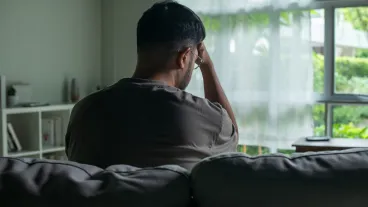
Men's suicide risk can persist for years following relationship breakdown
Men who experienced an intimate partner relationship breakup or separation have significantly higher rates of suicidal thoughts and attempts than men who had not, even years later, according to new research from the Australian Institute of Family Studies (AIFS).
Drawing on data from Ten to Men, the world’s largest longitudinal study on male health, the report explores the experiences of more than 20,000 men aged 15-67.
In 2024, almost 31% of men who had experienced a relationship breakdown in the previous year reported suicidal thoughts, compared with 14% of men who had not. Men who had recently separated were also around 7 times more likely to report a suicide attempt (7% compared with 1%).
The increased risk persists over time. Men who experienced relationship breakdown were up to 3.7 times more likely to attempt suicide 1-2 years later, and still around 2.8 times more likely 3-4 years on, even after accounting for prior risk factors.
The research also shows this heightened risk is seen broadly across different groups of men, supporting a population wide response.
Other key findings include:
- Recent suicidal thoughts in men were most strongly linked to relationship breakdown occurring in the same year, while the risk of suicide attempts tended to emerge later, beyond the initial separation period.
- The association between relationship breakdown and suicide risk remained even after accounting for age, income, employment, social support and prior suicidal thoughts.
- Rates of recent suicidal thoughts have increased over time among all men, rising between 2013–14 and 2024 for both those with and without recent relationship breakdown.
- The findings point to the need for responses that address both immediate distress following relationship breakdown and the longer-term risk of suicide attempts, with support that remains accessible over time and responsive to men’s changing needs.
Ten to Men is the largest longitudinal study on male health and wellbeing in the world. Funded by the Department of Health, Disability and Ageing, the study follows around 24,000 men, asking them about significant issues such as health service usage, mental health, social connection, family safety, fathering supports and risky health behaviours.
Attributable to Longitudinal Head, Ten to Men, Australian Institute of Family Studies, Dr Sean Martin:
“The findings highlight relationship breakdown as a major life transition associated with elevated suicide risk for men. Separation can bring a cluster of changes all at once – disruption in contact with children, changes in housing or finances, and a shrinking support network. These pressures often don’t occur in isolation, and the emotional impact can build rapidly, particularly in the months immediately following a breakup.
“Suicidal distress and suicide attempts don’t follow the same timeline. Some men appear to experience distress soon after separation, while others may cope initially but continue to struggle over time – perhaps as the practical and emotional consequences of separation accumulate. Our data highlights the importance of ongoing follow-up – not just in the weeks after separation, but in the years that follow.”
Attributable to Carolyn Last, Senior Manager Kew at Relationships Australia Victoria:
“Relationship breakdown is a significant turning point for many men, and it can have ongoing implications. We often see men struggling with grief, isolation and loss of identity, especially for fathers, which can increase vulnerability to suicidal thoughts and behaviours if they don’t receive help at the right time.
“Relationship services are uniquely placed to identify men at risk, and provide integrated, timely and accessible support. When men are struggling with significant life changes and navigating multiple service systems, they can be a trusted support option without men having to re-tell their stories. Ensuring these services are resourced to recognise distress, engage men effectively, and provide them with specialist, ongoing support is a critical suicide prevention measure.”
Attributed to Special Envoy for Men’s Health Dan Repacholi MP:
“Breaking up is tough at the best of times, but for some blokes it can be the start of a really difficult period. This research is a reminder that the impact of separation can stick around long after the relationship ends. We need to make sure support is there for men over the longer term, because staying connected can make all the difference.
“Too many men try to carry everything on their own. If you're going through a separation, don't wait until you're at breaking point. Reach out to your mates, your family, your GP or a support service. Asking for help is a sign of strength, not weakness.”
If you or someone you know needs support, phone Lifeline on 13 11 14 or the Suicide Call Back Service on 1300 659 467. Call 000 if there is immediate danger.
For guidance reporting about suicide safely and appropriately in the media: www.mindframe.org.au
Media contact
Simone Redman-Jones
Phone: 0402 786 097
Email: [email protected]
18 June 2026