Early intervention for young people’s mental health: Guidance for community-based services
Overview
This resource presents a framework for understanding early intervention in community-based mental health supports for children and families. It covers the:
- difference between mental health and mental illness
- definitions of the main provision levels of early intervention (promotion, prevention, early identification and case management)
- challenges to providing early intervention supports.
This practice guide has been developed for practitioners working in Family Mental Health Support Services (FMHSS). FMHSS provide early intervention and non-clinical community mental health support for children and young people, aged up to 18 years, who are showing signs of, or are at risk of, developing mental illness.
This practice guide will also be useful to other practitioners working with children and young people, parents and families. The content has been developed specifically for practitioners who have less than 5 years of experience in the child and family services sector.
Introduction
Early intervention mental health services are particularly valuable for children and young people (young people, hereafter).1 This is because signs and symptoms of mental ill-health often present during infancy, childhood and adolescence (McGorry & Mei, 2018). These periods also involve rapid changes in young people’s behavioural, social and emotional functioning (US Institute of Medicine and National Health Commission, 2019a).
As such, young people experience significant changes in how they connect with others and make sense of their experiences, identity and the people and world around them (Emerging Minds, n.d. -b). Young people’s mental health is also affected by external social, cultural and environmental factors that are largely out of their individual control (US Institute of Medicine and National Health Commission, 2019b).
What is early intervention?
While there is no single definition for early intervention in mental health settings, in broad terms it is recognised as support provided to individuals, families and communities before more advanced interventions are needed (US Institute of Medicine and National Health Commission, 2019a; Victorian Council of Social Service [VCOSS], 2023).
Early intervention programs that focus on young people’s mental health commonly provide supports that reduce the impact of mental ill-health before young people reach a diagnostic threshold. That is, before young people who are at risk of, or are showing signs of, mental ill-health exhibit symptoms that would meet the criteria for a diagnosis of a mental health condition (Colizzi et al., 2020; National Mental Health Commission, 2021; US Institute of Medicine and National Health Commission, 2019a).
Practitioners in early intervention mental health services commonly work with young people, their families and communities to promote protective factors that can positively influence mental health and to mitigate risk factors (US Institute of Medicine and National Health Commission, 2019b).
However, there can be some confusion about what types of services and supports can be considered ‘early intervention’, and where early intervention programs fit within the broader mental health system. This confusion partly comes from the broad but non-specific use of several related terms. For example, terms such as mental health ‘promotion’ and ‘prevention’ are sometimes used as though they are separate to early intervention. However, both ‘promotion’ and ‘prevention’ are better understood as levels within the range of early intervention responses.
This resource describes the difference between mental health and mental illness, provides a clear framework for understanding the multiple levels of mental-health early intervention and provides some examples of program types to help illustrate the different levels of early intervention. It also identifies some of the key challenges for the provision of mental-health early intervention.
What is the difference between mental health and mental illness?
Before focusing on early intervention support in more detail, it is useful to consider the difference between ‘mental health’ and ‘mental illness’. This resource has been developed with these foundational points in mind.
Everyone has ‘mental health’, just as they have physical health. The quality of a person’s mental health varies across their lifetime according to their ability to function in their day-to-day life, manage emotions, cope with challenging situations, develop relationships with others and enjoy life (Australian Institute of Health and Welfare [AIHW], 2021; headspace, n.d.). The ability to function, manage and enjoy life is often referred to as ‘good mental health’ (or being mentally healthy).
People can also experience poor mental health; this can mean not coping well with daily life, struggling with difficult emotions or not enjoying life.
Poor mental health is not necessarily the same as ‘mental illness’. The term mental illness usually refers to a diagnosable disorder, identified by medical professionals based on a set of symptoms that significantly interfere with cognitive, emotional or social functioning (AIHW, 2021). For example, a young person without a diagnosed mental illness may experience poor mental health due to exam stress or a relationship break-up.
This poor mental health may negatively affect the young person’s ability to cope with daily life but does not necessarily constitute a diagnosable mental illness. Likewise, a young person may experience mental illness (e.g. be diagnosed with generalised anxiety disorder) but have periods of functioning well (i.e. good mental health) due to life circumstances and/or professional and social support.
This animation by Emerging Minds explains well the ways young people can communicate how their mental health is and how adults can be supportive .
The difference between mental health and mental illness is sometimes called the dual model of mental health (Everymind, 2017). This is shown in Figure 1. People can be living with a mental illness and have good mental health and wellbeing, just as someone can have no diagnosable mental illness but be experiencing poor mental health (Everymind, 2017). An individual’s position on the model, and their support needs, will change throughout their life (Kelly et al., 2017).
Figure 1: Dual model of mental health
Source: Adapted from Everymind (2017)
The growing recognition of the fluid and dynamic nature of mental health and mental illness has led to changes in the way we think about young people’s mental health and wellbeing. This includes a shift away from a primary focus on diagnosable ‘mental illness’ to an increased recognition and understanding that a person can be mentally unwell without having a diagnosable illness.
This represents a shift in language and thinking away from terminology and concepts that may be stigmatising or too narrow to capture the full range of a young person’s emotional experiences and responses (National Mental Health Commission, 2021). It reminds us that regardless of whether a young person has a diagnosable ‘mental illness’, people’s experiences of mental health, and their need for support, change over time and according to circumstances.
Focusing on how someone is functioning, rather than diagnosis, can help practitioners identify opportunities to provide early intervention support to young people who may be struggling before they become seriously unwell.
Early intervention in mental health
There is no single clear definition or framework of what early intervention is in a mental health context. This can cause confusion about what it looks like in practice.
However, one useful framework for understanding early intervention in community-based mental health is the Mental Health Intervention Spectrum (Institute of Medicine, 1994; US Institute of Medicine and National Health Commission, 2019a, 2019b).
This framework is useful for understanding levels of early intervention support contextualised within the broader mental health system. It provides an outline of the different levels of mental health support, the types of activities that typically fall under each level and which levels and types of mental health support are commonly described as early intervention.
This model has evolved as understandings of mental health have changed. Early versions of the Mental Health Intervention Spectrum only included levels relating to prevention and treatment of signs of mental ill-health and maintenance of mental health care (US Institute of Medicine, 1994).
Updated versions of the spectrum include promotion of positive mental health and mental health awareness (US Institute of Medicine and National Health Commission 2019a, 2019b). These additions reflect changes in our understanding of mental health and mental illness and of the range of ways in which supports can be provided to individuals, families and communities before clinical treatment is needed.
In Figure 2, we have further updated and adapted the Mental Health Intervention Spectrum2 to reflect current understandings of mental health and mental ill-health interventions.3
Figure 2: Adapted Mental Health Intervention Spectrum
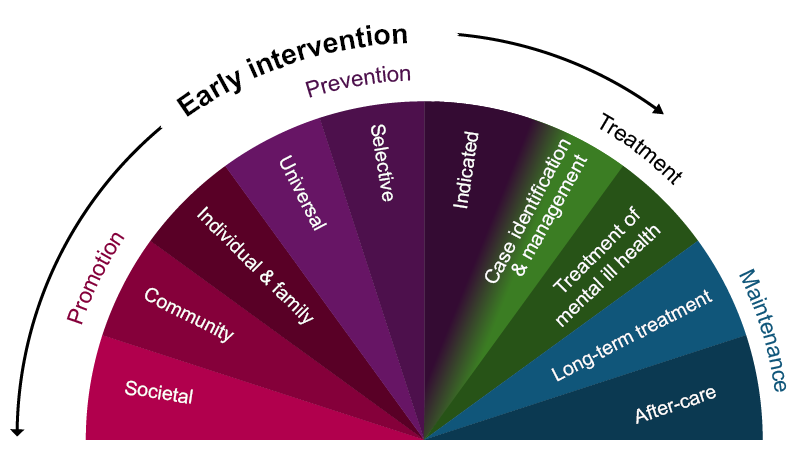
Early intervention spans 3 levels of the Mental Health Intervention Spectrum. Later in this practice guide, we describe the levels of service provision in mental health early intervention, including practical examples of what interventions at these levels can look like.4 The 3 broad levels of early intervention service provision are:
The ‘promotion’ and ‘prevention’ levels of the spectrum fall entirely within what can be described as early intervention. The ‘treatment’ and ‘management’ levels of this spectrum typically fall outside of early intervention and primarily relate to clinical settings. For example, the latter might include higher complexity cases that are assessed and managed through public Child and Adolescent Mental Health Services (CAMHS) or within private psychological services.5
Although the Mental Health Intervention Spectrum mostly positions ‘treatment’ and ‘maintenance’ as outside early intervention, it is also important to note that, in practice, the boundaries between the 4 levels – that is, promotion, prevention, treatment and maintenance – can be somewhat fuzzy.
Of particular interest for community-based early intervention mental health practitioners, ‘case identification and management’ still sits within early intervention, despite being part of the treatment level of this spectrum. This is discussed further below.
It is also important to understand that ‘early’ is relative to whatever a service is seeking to intervene with. That is, some early intervention mental health services may be ‘earlier’ than others. For example, FMHSS often intervene before young people reach a diagnostic threshold for mental ill-health, whereas a service working in suicide prevention may consider early intervention to be intervening before a suicide attempt.
Levels of service provision in mental health early intervention6
Promotion as early intervention
Mental health promotion focuses on strengthening protective factors against poor mental health and mental ill-health in societies, communities, families and individuals. The focus of promotion is not aimed at treating individuals but at increasing mental health literacy to improve people’s awareness of when, how and where they can seek help when they need it.
Mental health promotion aims to empower individuals, families, communities and societies with skills and knowledge that can support people to feel more in control of their mental health and the internal and external factors that influence it (Colizzi et al., 2020).
Mental health promotion also aims to minimise social and community-wide factors that have a negative impact on mental health, such as negative attitudes towards mental ill-health and discrimination.
Mental health promotion can work on different scales: societal, community and individual.
- Societal: Promotion can be delivered on a large-scale to emphasise the importance of positive mental health and wellbeing (Everymind, 2017). Societal promotion focuses on simple, low effort ways that people can shift their everyday thinking and behaviours to promote better mental health. It may be delivered in several ways, including via print and television and radio advertising. RUOK Day is a societal promotion that aims to normalise and encourage meaningful conversations about mental health and raise awareness about good mental health.
- Community: Promotion can also be developed in collaboration with or by community leaders and members to build knowledge and skills that promote understanding about mental health. It commonly involves communication targeted towards specific cohorts with a shared identity or background. Activities can range in scale.
- A large-scale example is the recent partnership between the National Rugby League’s Brisbane Broncos and the Black Dog Institute. In one round of competition, the Broncos wore completely black uniforms, absent of any branding or advertising. This was intended to catch the attention of fans and encourage conversation about mental health. The uniform change was accompanied by the launch of an online wellbeing hub for fans.
- A service-level example could be incorporating cultural practices in community engagement activities to build rapport as well as awareness and recognition of how important cultural safety is to mental health. This type of promotion might happen before screening activities formally begin and before starting psychoeducation. An example could be hosting a weaving session, facilitated by an Indigenous practitioner, for young people and their families.
- Grassroots examples might include First Nations community action groups who hold gatherings and walks, and hand out community-created resources, to promote good mental health.
- Individual and family: Promotion may take place more directly when practitioners work with families or individuals. For example, a practitioner working with a family may aim to build their knowledge about mental health by having non-challenging conversation starters, such as giving a young person or family a printout that explains ways to manage stress and the importance of sleep, exercise and nutrition for mental health.
Prevention as early intervention
Since the late 1990s, it has been increasingly recognised that a person can be ‘at risk’ of developing a mental illness, or struggling with some aspects of their mental health, but not yet meet diagnostic criteria for a mental illness. This has prompted more focus on ‘prevention’ (Colizzi et al., 2020; McGorry & Mei, 2018; US Institute of Medicine and National Health Commission, 2019a).
Prevention activities aim to build people’s skills and knowledge to support their capacity to function in their day-to-day lives, to manage emotions, cope with challenging situations and to reduce the incidence and/or severity of poor mental health and mental illness (Colizzi et al., 2020).
There are 3 types of prevention:7
- Universal prevention can be delivered to any young person, including those with a low risk of developing mental ill-health (US Institute of Medicine, 1994). For example, this kind of prevention can include school-wide psychoeducation interventions, such as those aiming to enhance social skills, problem solving or stress management.
- Selective prevention provides additional support for groups of young people who are recognised as being more likely to develop mental ill-health due to biological, individual, familial or social factors (US Institute of Medicine, 1994). Examples of this kind of prevention include programs such as:
- Stormbirds, which aims to reduce the impact of change and loss on young people following natural disasters
- Seasons for Growth, which supports children and young people who have experienced change and loss.
- More targeted, indicated prevention can be delivered directly to individuals who have a high risk of developing mental ill-health but currently have minimal signs or diagnosable symptoms (US Institute of Medicine, 1994). This might include:
- one-on-one counselling supports provided to young people
- family group counselling
- programs such as Managing the Bull, a program to support young people experiencing bullying
- programs such as BRAVE, a program to help children and young people better understand and cope with mental health issues. The BRAVE program also has programs directed to parents/carers providing psychoeducation on supporting young person who may be struggling.
Treatment in early intervention
The ‘treatment’ level of the Adapted Mental Health Intervention Spectrum (Figure 2) includes 2 types: (a) case identification and management and (b) treatment of mental ill-health. Treatment of mental ill-health primarily takes place in clinical settings (such as community-based private psychological or psychiatric services and in-patient hospital care) and is generally considered outside the scope of early intervention. Case identification and management, however, often sits within early intervention.
In this section we explain how and why case identification and management are often part of early intervention and provide examples of what this can look like.
Case identification and management as a form of early intervention
Community mental health practitioners often play a key role in identifying signs that a young person is experiencing, or at an increased risk of, mental ill-health (i.e. case identification) and when that young person may benefit from more specialist support services.
In some cases, interactions with community mental health practitioners may be the first opportunity a young person has had to talk to a safe adult about mental health concerns, things they feel stressed about or situations they feel unable to cope with. Therefore, early intervention support services can be a critical first access point for young people who would benefit from higher levels of support (Emerging Minds, n.d.-a).
Community mental health practitioners also play an important role in case management and supporting the transition to specialist services. This can include finding appropriate specialist services and helping young people and their families to access them (e.g. by providing information about services, providing referrals, assisting with applications). It can also include providing ongoing support and strategies while people wait to access specialist services (Emerging Minds n.d.-a).
An example of case identification and management in early intervention is the role that practitioners working in school-based universal prevention programs can play. These practitioners can provide a safe space for young people to think about their own and their peers’ mental health. Young people may also find these practitioners to be safe adults who they feel comfortable talking to about their mental health.
In this context, early intervention practitioners are in a unique position to identify more serious mental health concerns. They may also be able to facilitate the young person’s access to appropriate services through providing information and within-scope supports such as psychoeducation, risk assessment and referral when appropriate.
Case identification and management can also be considered a form of early intervention in the context of one-on-one and group supports for young people and their families. The fluid and dynamic nature of mental health (described earlier) means that a child or young person’s wellbeing and symptoms of mental ill-health can fluctuate over the course of multiple sessions of selective and indicated prevention programs.
For example, a young person accessing supports for stress management or to develop their social skills through a universal prevention program may experience an unexpected crisis and require immediate but short-term specialist support. In this situation, the role of early intervention practitioners may require identifying and assessing these changes for the young person, adjusting support plans and goals and facilitating their access to and transition between services. This is the point where early intervention prevention becomes early intervention treatment.
Early intervention practitioners often work across the mental health, social and community sectors to create clear pathways to services for young people needing additional support (Everymind, 2017). This can involve coordinating care and advocating on the young person’s behalf to decrease the individual burden of navigating health, social and community services (Colizzi et al., 2020; National Mental Health Commission, 2021).
This coordination role is particularly important when working in underserviced regions, with additional consideration and care needed when clients are from a marginalised background or have complex needs (Driver, 2024; Hurd & Young, 2023; National Mental Health Commission, 2021).
Other examples of early intervention practitioners providing case management support include:
- supporting young people and their families to make informed decisions about their care through information sharing and collaborative planning
- providing emotional support during complicated referral processes
- helping young people and their families access resources and information about a new diagnosis from reputable sources
- working with young people, families and communities to promote good mental health, enhance external protective factors and minimise external risk factors (Colizzi et al., 2020; Everymind, 2017). This can involve work focusing on social, emotional, cognitive and social skills (Colizzi et al., 2020; Savaglio et al., 2022).
Challenges in providing early intervention
The Mental Health Intervention Spectrum is a useful idealised tool for visualising what kinds of supports should be provided when. In reality, service provision is likely to be messier. For example, young people may not present to or be able to access services as early as would be ideal or may not stay engaged with services at a time when they need them.
There can also be a blurring of the lines between different ‘levels’ of support, with some young people accessing both early intervention and later stage supports at the same time or moving up and down the spectrum of support types (e.g. from early intervention to treatment, back to early intervention).
This is partly because the way that mental health can present in any individual is complex. People’s needs will change over time, and they may not move up or down the spectrum level by level. Instead, they might jump from receiving selective prevention supports at school to receiving treatment for mental illness in a private psychological service.
It is also partly because the mental health system is complex and different activities or levels of the spectrum will overlap and interact with one another, rather than being distinct or following a consecutive order (e.g. a clear progression from prevention to early intervention to treatment).
Table 1 highlights some of the practical challenges that early intervention services can face. Broadly speaking, challenges fall under 4 categories: community challenges; practice challenges; systemic challenges; and limitations of mainstream service design. However, it is important to be aware that the challenges under each heading will overlap and interact with one another.
| Challenge type | Examples of challenges |
|---|---|
| Community challenges | Identifying a possible problem
Decisions not to access support
|
| Practice challenges | Increasing case complexity
Delays in accessing appropriate supports
|
| Systemic challenges | Services functioning at capacity
Accessibility
Cross-service coordination
|
| Limitations of mainstream service design | Many mainstream services that support young people and their families face challenges in providing a service that is welcoming, empowering and representative of all community members. In a community mental health context, the following factors can prevent young people and families from seeking support. They may also result in disengagement for families who have previously accessed supports.
|
Sources: Commissioner for Children and Young People Western Australia, 2013; Cross & Hickie, 2017; Driver, 2024; Emerging Minds, n.d.-a; Garay et al., 2023; Hobson et al., 2022; Hurd & Young, 2023; Kilian & Williamson, 2018; LBGTIQ+ Health Australia, 2023; McDermott et al., 2024; McGorry & Mei, 2018; Naeem et al., 2024; National Mental Health Commission, 2021; O’Brien et al., 2016; Place et al., 2021; Platell et al., 2017; Reardon et al., 2017; Royal Far West, 2018; Sapiets et al., 2022; Savaglio et al., 2022; YLab, 2020
Many of the challenges outlined in Table 1 are outside the control of individual family-facing practitioners. Some require consideration at service management and mental health system levels. Many of these challenges interact to further impede timely access to early intervention services, particularly for young people and families experiencing marginalisation.
However, while practitioners may not have control over waitlists or a lack of specialised services, there can be ways to work around feelings of frustration or powerlessness. Our consultations with program managers suggested that it can be useful to encourage teams to focus on the things that are within their control; for example, providing quality and responsive support to the young people they work directly with. Some program managers also felt that it can help raise practitioners’ morale to keep in mind that eligible young people on waitlists will reach the front eventually and will be seen and supported.
Other examples of focusing on what you can control include early intervention teams collating and sharing ‘while you wait’ packs of resources relevant to the young person’s needs. Practitioners told us that it is useful to have multiple tailored information packs related to common issues young people are managing while on a waitlist.
Further reading and resources
- In focus: Prevention and early intervention
This webpage, from Emerging Minds, provides information on where prevention and early intervention sit on the spectrum of mental health interventions. It outlines the differences between prevention and early intervention and describes how to recognise symptoms of mental health problems and how prevention and early intervention can support families. - National practice standards for the mental health workforce 2013
This document includes information on how practice standards align with discipline-specific and service standards, the values and attitudes on which all workers are expected to base their practice, and the knowledge and skills that must be applied to meet the national standards of practice. - National Children’s Mental Health and Wellbeing Strategy
The National Children’s Mental Health and Wellbeing Strategy provides a framework to guide investment in the mental health and wellbeing of children and families in Australia. It provides clear pathways for proactively promoting child wellbeing and helping those who are struggling as early as possible to reduce long-term impacts of poor mental health. - Early intervention in youth mental health: Progress and future directions
Over the past decade, there has been a major shift in momentum for early intervention in youth mental health to be taken more seriously. This paper discusses recent advances and evidence to support an innovative integrated model of youth mental health care. - Prevention and early intervention in youth mental health: Is it time for a multidisciplinary and trans-diagnostic model for care
This review paper delves into the current state of knowledge on delivering promotion and preventive interventions addressing youth mental health. It includes information about universal, selective and indicated primary prevention strategies.
Early intervention and prevention for specific cohorts
- Early intervention for children with disability
This Emerging Minds webpage offers information for parents about early intervention services that provide specialised support to children and families living with disability, autism spectrum disorder (ASD), developmental delay and other additional needs. It includes information about what early intervention is and how it works. - Getting it right in the early years
This report, from the Lowitja Institute and ARACY, comprises 3 papers that explore a synopsis of the evidence about the importance of a healthy start to life and evidence-based early interventions to promote a healthy start to life for Aboriginal and Torres Strait Islander children and their families. - MindOut: Mental health and suicide prevention
Although many LGBTIQ+ Australians live healthy and happy lives, a disproportionate number experience poorer mental health outcomes and have higher risk of suicidal behaviours than their peers. MindOut, run by LGBTIQ+ Health Australia, develops and delivers national suicide prevention initiatives, including webinars, and professional development for the mental health and suicide prevention sectors to help them meet the needs of LGBTIQ+ populations. - Resilient Kids Toolkit
This toolkit, developed by Royal Far West, is filled with many easy-to-follow strategies for parents and activities for kids. It’s designed to help develop positive relationships, strengthen mental health and build resilience and self-awareness. This resource is developed with rural and remote children and young people in mind. - Multicultural Mental Health Network
The Ethnic Communities Council of Victoria (ECCV) established the Multicultural Mental Health Network to inform the state’s reform process. The network promotes the needs and perspectives of migrant and refugee communities through an evidence-informed, strategic approach to policy and design and provides a key platform for agencies, researchers, clinical experts, advocates and people with lived experience to share information and collaborate. They hold mental health workshops for practitioners in the mental health sector who work with people from migrant and refugee backgrounds to help understand the factors impacting poorer mental health outcomes for multicultural communities.
Supporting child and adolescent mental health
- Making your practice trauma-informed
AIFS has a guide on how to practice in a trauma-informed way as well as an interactive online training course on trauma-informed practice. Both resources summarise the research and practice evidence on strategies for trauma-informed practice. - Neurodiversity-affirming practice in community mental health services
This AIFS practice guide presents a framework for family and community services to apply neurodiversity-affirming practice (NAP) to their work with all children, young people and families. It has been developed for, and in consultation with, practitioners providing early intervention mental health supports to children, young people and their families. The content will also be useful for program managers supporting and enabling the work of frontline practitioners. - Managing uncertainty in professional practice
Practitioners who work with children and families often experience uncertainty in their role, including around understanding a client’s challenges, progress or responses to support. This practice guide, from CFCA, provides an overview of what uncertainty and uncertainty tolerances are, their significance to professional practice and evidence-based strategies for how practitioners can manage practice uncertainties. - What works to improve young children’s social, emotional and behavioural wellbeing?
The development of social, emotional and behavioural skills is crucial to children’s development. However, some children experience difficulties that may compromise their development and future opportunities. This rapid evidence review identifies national and international prevention and early intervention programs that are effective at improving the social, emotional and behavioural health of at-risk children, aged under 5. - Children’s Wellbeing Continuum
This resource from the Centre for Community Child Health at the Murdoch Children’s Research Institute is an evidence-base tool developed to support conversations around children’s wellbeing. It can be used by parents, teachers and service providers. - What are adverse childhood experiences (ACEs)?
Adverse childhood experiences (ACEs) can impact children’s relationships, sense of self and perceptions of the world around them. This webpage, from Emerging Minds, explores common ACEs and how ACEs affect health and functioning and how practitioners and organisations can support children and families. - Mental health literacy and interventions for school-aged children
Evidence suggests that Australian youth are increasingly facing mental health challenges but that there are barriers to them accessing appropriate supports, including a lack of mental health literacy. This short article discusses how practitioners can incorporate mental health literacy interventions in school environments. - The impact of community mental health programs for Australian youth: A systematic review
This systematic review describes the types of community-based mental health programs delivered in Australia and examines their impact to improve young people’s mental health. - Engaging children and young people in digital mental health interventions: Systematic review of modes of delivery, facilitators and barriers
There is a high prevalence of children and young people experiencing mental health problems worldwide. This systematic review highlights the development and incorporation of digital health interventions that have been shown to have the potential to improve mental health outcomes in this cohort.
How this practice guide was developed
The literature reviewed for this practice guide was identified through a scoping of the mental health literature, specifically, and social services literature, more broadly. The research team also scoped government and social services websites and conducted consultations with frontline mental health practitioners who provide early intervention supports for young people and their families.
Consultations included staff and managers in metro, regional and rural areas Australia-wide. A second round of consultations with frontline mental health practitioners and managers was undertaken at the draft stage to sense check the practice guide content and to add relevant practice examples.
References
Australian Institute of Health and Welfare (AIHW). (2021). Australia’s youth: Mental illness.
www.aihw.gov.au/reports/children-youth/mental-illness#psychological
Colizzi, M., Lasalvia, A., & Ruggeri, M. (2020). Prevention and early intervention in youth mental health: Is it time for a multidisciplinary and trans-diagnostic model for care? International Journal of Mental Health Systems, 14(1), 1–14. doi.org/10.1186/s13033-020-00356-9
Commissioner for Children and Young People Western Australia. (2013). The mental health and wellbeing of children and young people: Children and young people with disability. www.ccyp.wa.gov.au/media/uhjlha5a/policy-brief-mental-health-children-and-young-people-with-disability-february-2013.pdf
Cross, S. P., & Hickie, I. (2017). Transdiagnostic stepped care in mental health. Public Health Research & Practice, 27(2). doi.org/10.17061/phrp2721712
Driver, R. (2024). Mental health service accessibility for young people in rural, regional and remote areas and its implications for social work practice: A scoping review protocol. Social Work in Mental Health, 22(5), 734–753. doi.org/10.1080/15332985.2024.2368594
Emerging Minds. (n.d.-a). In focus: Prevention and early intervention. Emerging Minds. emergingminds.com.au/resources/in-focus-prevention-and-early-intervention/?audience=family
Emerging Minds. (n.d.-b) What is infant and child mental health (and why is it important)? Emerging Minds. emergingminds.com.au/resources/what-is-infant-and-child-mental-health-and-why-is-it-important
Everymind. (2017). Prevention First: A prevention and promotion framework for mental health. Newcastle, NSW: Everymind. everymind.imgix.net/assets/Uploads/EM-0026-Prevention-First-Framework.pdf
Garay, J., Williamson, A., Young, C., Nixon, J., Cutmore, M., Sherriff, S. et al. (2023). Aboriginal young people’s experiences of accessibility in mental health services in two regions of New South Wales, Australia. International Journal of Environmental Research and Public Health, 20(3), 1,730.
doi.org/10.3390/ijerph20031730
headspace. (n.d.) What is mental health? What is mental illness? headspace. headspace.org.au/assets/download-cards/19-What-is-mental-health-headspace-fact-sheet-WEB.pdf
Hobson, H., Kalsi, M., Cotton, L., Forster, M., & Toseeb, U. (2022). Supporting the mental health of children with speech, language and communication needs: The views and experiences of parents. Autism & Developmental Language Impairments, 7. doi.org/10.1177/23969415221101137
Hurd, N. M., & Young, A. S. (2023). Introduction to the special issue: Advancing racial justice in clinical child and adolescent psychology. Journal of Clinical Child & Adolescent Psychology, 52(3), 311–327.
doi.org/10.1080/15374416.2023.2202255
Kelly, C. M., Kitchener, B. A., & Jorm, A. F. (2017). Mental health problems in Australian youth. In Youth mental health first aid: a manual for adults assisting youth (4th ed.). Mental Health First Aid Australia.
Kilian, A., & Williamson, A. (2018). What is known about pathways to mental health care for Australian Aboriginal young people? A narrative review. International Journal for Equity in Health, 17(1).
doi.org/10.1186/s12939-018-0727-y
LGBTIQ+ Health Australia. (2023). Beyond urgent: National LGBTIQ+ mental health and suicide prevention strategy 2021–2026. LGBTIQ+ Health Australia. www.lgbtiqhealth.org.au/strategy
McDermott, E., Eastham, R., Hughes, E., Pattison, E., Johnson, K., Davis, S. et al. (2024). Early mental health intervention and supported self-care for LGBTQ+ young people in the UK: A mixed-methods study. UK National Institute for Health and Social Care Delivery Research, 12(47). doi.org/10.3310/KYWA6382
McGorry, P. D., & Mei, C. (2018). Early intervention in youth mental health: Progress and future directions. Evidence-Based Mental Health, 21(4), 182–184. doi.org/10.1136/ebmental-2018-300060
Naeem, F., Khan, N., Sohani, N., Safa, F., Masud, M., Ahmed, S. (2024). Culturally Adapted Cognitive Behaviour Therapy (CaCBT) to improve community mental health services for Canadians of South Asian origin: A qualitative study. The Canadian Journal of Psychiatry, 69(1), 54–68.
doi.org/10.1177/07067437231178958
National Mental Health Commission. (2021). National Children’s Mental Health and Wellbeing Strategy. National Mental Health Commission. www.mentalhealthcommission.gov.au/projects/childrens-strategy
O’Brien, D., Harvey, K., Howse, J., Reardon, T., & Creswell, C. (2016). Barriers to managing child and adolescent mental health problems: A systematic review of primary care practitioners’ perceptions. British Journal of General Practice, 66(651), e693-e707. doi.org/10.3399/bjgp16X687061
Place, V., Nabb, B., Gubi, E., Assel, K., Ahlen, J., Hagstrom, A.. (2021). Perceived barriers to care for migrant children and young people with mental health problems and/or neurodevelopmental differences in high-income countries: A meta-ethnography. BMJ Open, 11(9). doi.org/10.1136/bmjopen-2020-045923
Platell, M., Cook, A., & Martin, K. (2017). Barriers to mental health care for disadvantaged adolescents: Perspectives of service providers. Advances in Mental Health, 15(2), 198–210.
doi.org/10.1080/18387357.2017.1317216
Reardon, T., Harvey, K., Baranowska, M., O’Brien, D., Smith, L., & Creswell, C. (2017). What do parents perceive are the barriers and facilitators to accessing psychological treatment for mental health problems in children and adolescents? A systematic review of qualitative and quantitative studies. European Child & Adolescent Psychiatry, 26(6), 623–647. doi.org/10.1007/s00787-016-0930-6
Royal Far West. (2018). The Invisible Children: The state of country children’s health and development in Australia. The Centre for Community Child Health at the Royal Children’s Hospital. www.royalfarwest.org.au/wp-content/uploads/2019/02/The-Invisible-Children-Report.pdf
Sapiets, S. J., Hastings, R. P., Stanford, C., & Totsika, V. (2022). Families’ access to early intervention and supports for children with developmental disabilities. Journal of Early Intervention, 45(2), 103–121.
doi.org/10.1177/10538151221083984
Savaglio, M., O’Donnell, R., Hatzikiriakidis, K., Vicary, D., & Skouteris, H. (2022). The impact of community mental health programs for Australian youth: A systematic review. Clinical Child and Family Psychology Review, 25(3), 573–590. doi.org/10.1007/s10567-022-00384-6
US Institute of Medicine. (1994). New directions in definitions. In P. J. Mrazek & R. J. Haggerty (Eds.), Reducing risks for mental disorders: Frontiers for preventive intervention research (pp. 19–29). National Academies Press. doi.org/10.17226/2139.
US Institute of Medicine and National Health Commission. (2019a). Introduction. In Fostering healthy mental, emotional, and behavioral development in children and youth: A national agenda (pp. 13–30). The National Academies Press. doi.org/10.17226/25201
US Institute of Medicine and National Health Commission. (2019b). Part I: Mental, emotional, and behavioural Development. In Fostering healthy mental, emotional, and behavioral development in children and youth: A national agenda (pp. 31–90). The National Academies Press.
doi.org/https://doi.org/10.17226/25201
Victorian Council of Social Service (VCOSS). (2023). Collaboration on the early intervention investment framework. www.dtf.vic.gov.au/sites/default/files/2024-10/Collaboration-on-the-Early-Intervention-Investment-Framework-Recommendations-and-toolkit.pdf.PDF
YLab. (2020). Understanding young people’s access to mental health services. The Inner Metropolitan Partnership, Victorian Department of Transport and Planning. www.suburbandevelopment.vic.gov.au/__data/assets/pdf_file/0031/177349/Young-Peoples-Access-to-Mental-Health-Inner-Metropolitan-Partnership-Report.pdf
1 Throughout the practice guide, the term ‘young people’ covers people aged 0–18 years. The content has been developed to support practitioners working across this broad age group. However, practice examples covered in consultation and subsequently included in this practice guide tend to relate to school-aged children. This is because mental health referrals most commonly involve school-aged and older children and adolescents.
2 In this resource we refer to all versions of the spectrum as the Mental Health Intervention Spectrum despite later versions of the spectrum being referred to as the Mental Health Promotion Spectrum. This is because promotion is only one level of the spectrum and the spectrum also encompasses the specialist supports (i.e. non-early intervention supports) required in treatment and maintenance.
3 The first change we made was to the treatment section, which relates primarily to clinical settings. Here we have extended case identification to incorporate case management. We have also renamed the second treatment type to relate to treatment of mental ill-health, in line with the explanation provided above about the difference between mental health and mental ill-health. Finally, we have added an arrow to indicate that early intervention supports can occur through promotion, prevention and case identification and management. Our additions to this model are based on our review of the literature, expert and sector consultations and consideration of the specific context of the intended audience of this resource.
4 Based on a synthesis of relevant research and practice literature, policy documents and consultation with stakeholders.
5 Clinical settings, such as CAMHS and psychological services, are where diagnosis of mental illness occurs.
6 This section mentions mental health programs run by external organisations as examples of early intervention. Their inclusion here is for illustrative purposes and does not constitute an endorsement by AIFS or our funding bodies.
7 Prevention and promotion are not exclusive from each other. All levels of prevention can be used alongside promotion activities.
Acknowledgements
This practice guide was funded by the Australian Government Department of Social Services (DSS).
The authors are Dr Jasmine B. MacDonald, Holly Helprin, Lisa Tamiakis, Dr Stewart Muir and Kylie Butler, from the Australian Institute of Family Studies (AIFS). The authors conceptualised this resource, designed and conducted the literature review search and screening, conducted the data extraction, synthesis and stakeholder consultation, and co-wrote this practice guide.
Gillian Lord (AIFS) provided support accessing full-text research articles in the literature search and screening phase of this review. Lewis Munro supported the literature scoping.
Thank you to the individuals from the following groups who consulted on this project: DSS, Family Relationship Services Australia, Family Mental Health Support Services staff and team leaders, headspace Wagga Wagga staff and team leaders and Dr Will Dobud, Charles Sturt University.
Featured image: © GettyImages/AntonioGuillem
Suggested citation
MacDonald, J. B., Helprin, H., Tamiakis, T., Muir, S., & Butler, K. (2026). Early intervention for young people’s mental health: Guidance for community-based services. Practice guide. Melbourne: Australian Institute of Family Studies.
978-1-76016-449-2
4 May 2026
Related publications

Neurodiversity-affirming practice in community mental…
This practice guide presents a framework for family and community services to apply neurodiversity-affirming practice …

Trauma-informed practice in family mental health support…
This resource explores evidence-based practice strategies for practitioners and organisations delivering trauma…

Managing uncertainty in professional practice
This practice guide provides an overview of what uncertainty and uncertainty tolerance are and their significance to…