Income support payments and employment dynamics: The experience of humanitarian migrants in Australia
Policy brief
Overview
This policy brief investigates the employment transitions of nearly 2,200 humanitarian migrants in Australia and offers insights on the patterns and key drivers of the transition from income support payments to paid employment as a main income source. It draws on data from the Building a New Life in Australia (BNLA) longitudinal study over a 10-year period, from 2013–14 to 2023.
The first section examines how employment outcomes have evolved over time, identifying key trends in the shift away from government income support as a primary source of income. The second section examines the underlying factors that influence this transition and assesses which characteristics and circumstances are most strongly associated with changes in the main income source during the 5th and 10th years of settlement.
The analysis is guided by a multidimensional conceptual framework that models employment transition as a function of individual, structural and contextual factors. Results are presented by key outcomes (disaggregated by sex), with sensitivity analyses conducted to confirm robust evidence. The brief concludes with practical implications for policy and service delivery aimed at improving employment pathways for humanitarian migrants and supporting shifts away from long-term reliance on income support as the main source of income.1
Key messages
- There was a significant shift from reliance on income support payments to paid employment at the 5th year of settlement for humanitarian migrants (24% of women and 50% of men). Further improvement was observed for both men and women by year 10, although women’s transition to paid employment remained lower than that of men (41% of women and 63% of men).
- Early participation in English language study was associated with a 12 percentage point increase in short-term employment transitions among humanitarian migrants but the positive effect did not persist by year 10.
This pattern was consistent for both men and women, suggesting that while scaling up early language training improved early employment outcomes, English study alone was insufficient to deliver sustained long-term gains. - Early engagement in other studies or job training programs in Australia had a lasting positive impact on employment transition, particularly for men, who experienced a 22 percentage point increase by year 10. Women did not see similar gains, highlighting the structural barriers they faced during the early settlement period.
This reinforces the need for early intervention (e.g. child care support and recognition of prior skills) to ensure enduring improvements in employment outcomes, especially for women. - Pre-arrival education (e.g. university/technical degrees) was associated with a reduction in the transition to paid employment by 14 percentage points at the 5th year of settlement, indicating that overseas qualifications are not helping skilled humanitarian migrants translate their education into employment without extra support. This was seen among men but was not statistically significant for women.
Recognition of overseas qualifications remains complex and costly for humanitarian migrants and is one of several barriers preventing humanitarian migrants from translating their skills to employment, underscoring the need to simplify and streamline the process. - Pre-arrival work experience supported employment transitions over time, with the most pronounced impact observed at the 10th year of settlement. Women benefited notably by year 5, with a 13 percentage point increase, and men by year 10, with a 17 percentage point increase.
These gendered and time-sensitive patterns highlight the need for tailored support, such as streamlined skills assessments, bridging programs and targeted employment services to better leverage pre-arrival work experience, both in the long term for women and more immediately for men. - Humanitarian migrants with disability or long-term health conditions faced significant barriers to employment transitions over time. Those who reported disability or long-term health conditions at year 1 experienced consistently lower employment transitions over the settlement period. By year 10, these baseline health conditions were associated with a 21 percentage point lower likelihood of transition for women and a 27 percentage point lower likelihood for men, compared with those without such conditions.
These sustained challenges highlight the need for ongoing, tailored policy responses that address the structural and health-related barriers faced by humanitarian migrants living with disability or long-term health conditions. - Larger households – in terms of both the number of children and of adults – were more likely to experience reduced employment transitions. Households with more adults were associated with lower employment transitions – by 5 percentage points in year 5 and 11 percentage points in year 10. This effect persisted for women in both years and for men in year 10. These findings highlight the need for further investigation of the possible benefits of settlement and employment programs that offer flexible training, caregiving support and targeted outreach to households with multigenerational responsibilities.
Similarly, households with more children were associated with reduced employment transitions by 5 percentage points in year 5, likely due to caregiving demands. This was observed for both men and women over the same period but there was no significant impact on either men or women in year 10. While most settlement services offer tailored support to families with young children, the results show that the presence of children does not influence employment transitions by year 10, suggesting that caregiving responsibilities do not explain why some – particularly women – remain on income support over time. This points to other structural barriers beyond child care limiting women’s movement into paid work. - Diverse social networks increasingly supported employment transitions, particularly for men, who experienced a 22 percentage point increase by year 10. Sustained investment in settlement services that foster these networks is essential to promote long-term employment outcomes, particularly for men. Although the evidence for women (in this report) is limited, broader research suggests that social connectedness plays a vital role in supporting women’s employment outcomes. Further investigation is needed to understand how social networks influence employment transitions and how their structure and function may differ by sex among humanitarian migrants.
Background
Australia has a comprehensive and well-targeted social security system, which operates on a non-contributory basis, providing support to individuals unable to fully support themselves due to factors such as age, disability, caregiving responsibilities or unemployment. It encompasses income support payments as well as other forms of financial assistance.2 Access to government income support is available to humanitarian migrants3 as soon as they arrive in Australia (offshore visa holders4) or are granted permanent residency (onshore visa holders5) (Services Australia, 2025).6
The analysis of 10 years of BNLA data reveals that humanitarian migrants frequently receive extended income support payments. The most common payment type reported in Wave 1 of BNLA was the unemployment benefit (Figure 1), reflecting the unique challenges these migrants face compared to other migrant groups in gaining employment and rebuilding their lives in Australia.7
Many humanitarian migrants arrive in Australia with disrupted education, employment and social connections, putting them at a greater disadvantage in the job market than other applicants (Smart et al., 2017; van Kooy et al., 2024). Additionally, poor physical and mental health can significantly impact their ability to secure employment (Lai et al., 2022).8 Moreover, the lack of recognition of their qualifications, along with discrimination in the recruitment process, means they frequently struggle to secure employment, particularly opportunities that match their level of education (van Kooy et al., 2025). This disadvantage is reflected in the median personal incomes of humanitarian migrants, which are lower than those of both Australian-born people and other immigrants (Australian Bureau of Statistics [ABS], 2024) and may contribute to their distinct reliance on income support payments.
Long-term reliance on income support payments comes at a high fiscal cost for society, contributing to social problems (Macaluso, 2021) and reduced human capital. It can also have detrimental effects on individuals in terms of health (Shahidi et al., 2019),9 reduced work motivation and inability to improve their circumstances, leading to a continued reliance on income support payments (Mood, 2013).
The use of income support can vary within the humanitarian migrant population. For some BNLA participants, income support payments remained an important source of income over time, with 56% reporting income support as their main source of income in year 5 and 43% in year 10. At the same time, some participants who initially relied on income support later reported paid work as their main source of income, increasing from 33% in year 5 to 46% by year 10 (see Figures D1 and D2, Appendix D). These shifts reflect the diversity of circumstances across the cohort, including varying levels of health conditions, skills and work capacity and access to employment opportunities (see further discussion later in this brief).
Research conducted across other Organisation for Economic Cooperation and Development (OECD) nations highlights similar experiences among migrant populations globally (Hansen & Lofstrom, 2011; Heggebø et al., 2020; Königs, 2018; Mood, 2013). Although international evidence is informative, it may not fully apply to Australia due to differences in migration policy, labour market conditions and settlement services.10
In Australia, few studies have examined transitions from income support payments to employment. For example, Cortis and colleagues (2013) drew on qualitative interviews with employment service providers to explore ways to achieve sustained transitions from income support payments to employment for jobseekers experiencing disadvantage. Cai and colleagues (2008) provided quantitative evidence on dynamic changes from income support to work. However, neither study focused specifically on humanitarian migrants. This evidence gap underscores the need for longitudinal research to inform evidence-based policy for this group. Australia also presents an ideal case study due to the availability of comprehensive data on the settlement experiences and life-course outcomes of humanitarian migrants.
Understanding the dynamics between income support payments and the transition to employment, and the factors that influence them, has implications for policy and program interventions that support humanitarian migrants in Australia. Work is an important means to transition from reliance on income support payments to full economic participation. Understanding the factors that facilitate this transition is, therefore, crucial. More specifically, identifying these factors can help tailor assistance programs that empower humanitarian migrants and facilitate their economic integration.11
Figure 1: Types of income support payments
Notes: Weighted proportions and cross-sectional weights were applied to BNLA data. BNLA participants aged 15–59 (n = 2,077). Observations (n) represent the number of BNLA participants who responded to each item of income support payments (unweighted). Multiple payments can be selected, so percentages may sum to more than 100.0%. BNLA did not collect data on a specific government income support payment. Plain English labels were used to ensure consistency over time and to capture the likely requirements of the payment. For example, where participants selected ‘Family Assistance’, this reflects their self-reported category at the time of interview and may refer to payments under the Family Assistance system (e.g. Family Tax Benefit). Note that ‘Youth Allowance’ in Australia is delivered through 2 streams: one for students and Australian apprentices and another for job seekers but BNLA data does not capture this level of detail. The ‘Other’ payment type category reflects the question as worded in the data. The main analysis, therefore, focused on the broader category of income support payments as the main source of income, rather than the individual types.
Source: BNLA Wave 1 (Year 1: 2013–14)
Objectives
The aim of this policy brief is to provide a snapshot of the transition to employment among humanitarian migrants who self-reported income support as their main income source (as opposed to wages or salaries) in the BNLA study over a 10-year period. It uses a multidimensional conceptual framework to examine factors (e.g. English skills, other studies or job-related training and child care responsibilities) known to influence this transition.
Moving away from income support payments as a main source of income does not necessarily equate to full financial self-sufficiency. Due to the conditions of the type of government income support, personal or household income, means-testing and other eligibility criteria, humanitarian migrants who are employed may still receive income support at various stages; however, BNLA data indicate that such instances are minimal (see Table D13, Appendix D).
This study addresses the following research questions:
- What are the patterns of the transition from income support payments to employment among humanitarian migrants over a 10-year period?
- What factors influence the transition from income support payments to employment among humanitarian migrants over time?
The current study draws on data from the BNLA survey, which collected data on the settlement trajectories and outcomes of nearly 2,399 humanitarian migrants in Australia at 6 time points between 2013–14 and 2023. The data and approach section (Box 1) provides further details on the sample and study measures related to income support payments and employment used in this study, as well as the statistical methods employed to analyse the data.
Figure 2 shows the key BNLA variables used in the analysis to better understand the transition from income support payments to employment as the main source of income for humanitarian migrants.12 The choice of these variables has been informed by the adopted conceptual framework for exploring issues relating to these transitions (further details in Appendix A).
Figure 2: Conceptual framework
Factors associated with income support payments and employment transition
Building on the conceptual framework (Figure 2) – which explores how individual and contextual factors shape reliance on income support payments – this study takes a multidimensional approach to better understanding employment transitions among humanitarian migrants (for details, see Appendix A).
Research has highlighted that individual characteristics, such as health status, education level and caregiving responsibilities, interact with broader social aspects, the level of socio-economic disadvantage in the areas where they settle and local economic conditions to shape employment trajectories (Mood, 2013; Shergold, 2019). More specifically, these elements influence both access to job opportunities and the speed of financial self-sufficiency.
In light of these complexities, this study takes into account the factors shown in Figure 2 across 4 dimensions – individual, family and social support, neighbourhood characteristics and structural factors – to estimate the likelihood of employment transition among humanitarian migrants. The selection of these factors is driven by the availability of data in BNLA.
As part of the analysis, a set of demographic characteristics, such as age, sex, marital status and religion, is included in all models as controls to account for differences in individual circumstances that may influence employment outcomes and reliance on income support payments.13 These variables, while not the primary focus of the analysis, are essential to account for differences in individual circumstances that may influence employment outcomes and reliance on income support payments, and to isolate the impact of the main variables in the analysis.
Box 1: Data and approach
Study sample
This brief uses BNLA data from approximately 3 equal time points: Wave 1 (baseline data collected in 2013–14), Wave 5 (2017–18) and Wave 6 (2023), referred to as year 1, year 5 and year 10. The study sample includes BNLA participants aged 15–59 in year 1 to reflect that humanitarian migrants aged over 60 are unlikely to be active in the Australian labour market (van Kooy et al., 2025).
There were 2,229 participants aged 15–59 in year 1. Of these, 1,735 responded in year 5, and 1,132 of that group responded in year 10. The attrition rate increased substantially from 22% at year 5 to 49% at year 10 (see Figure D3, Appendix D). The analytic sample, however, comprised 2,182 year 1 participants who reported income support payments as their primary source of income (as opposed to wages, salaries or other forms of income).a In years 5 and 10, 1,697 and 973 of these participants, respectively, reported their main income source and were included in this analysis.
Government income support payment type was collected only in year 1, with 7% missing data, limiting longitudinal tracking of specific payments. In years 5 and 10, only the main income source was recorded (e.g. income support payments vs income from paid work), with 23% and 55% missing data, respectively. Most participants receiving income support payments in year 1 were on unemployment benefits and tended to transition to paid work over time. Reliance on disability, family, carer or parenting allowances was low among humanitarian migrants, and Age Pension recipients were excluded because the study was focused on participants of working age.
It is possible, however, that those in the 50–59 age group in year 1 may have moved onto the Age Pension by year 10. Because the payment type was not collected after year 1, this cannot be determined. Thus, findings relating to age groups should be interpreted as overall reliance on income support payments within this cohort, not specifically the Age Pension.
Outcome measures
The outcome variable is defined as the subset of humanitarian migrants who reported income support payments as their main income source in year 1 but transitioned to employment and reported wages or salaries as their main income source or received income support payments at year 5 and year 10. It is possible that participants who reported wages or salaries as their main income source at those time points may also have been receiving income support payments, with or without supplementary payments (e.g. Rent Assistance). However, in both years 5 and 10, about 71% and 80% of participants, respectively, who reported wages or salaries as their main income source were working more than 35 hours per week.
Note that participants’ status could change from being employed to being an income support recipient (see Figures D1 and D2, Appendix D); only transitions into employment were considered due to the very low employment rate (around 7%) in year 1 (Figure D4, Appendix D).
It is also important to note that the outcome measure used here captures only whether participants reported wages as their main source of income in a given survey year. It does not distinguish between continuous and intermittent work outside these time periods nor between the quality of the work. As a result, the term ‘transition to employment’ reflects a baseline-to-endpoint change rather than the quality, stability or continuity of work.
In this analysis, responses were coded as 1 for participants who reported a transition from income support payments to employment and 0 for those who received income support payments over time. Due to missing information on the type of income support payment and employment across years, this study considered 2 analytical approaches. The first approach examined transitions between year 1 and year 5, while the second extended the analysis to between year 1 and year 10, and these were referred to as the baseline models.
Approach 1:
Exit to work
= 1 if received govt income support in year 1 but entered the labour market in year 5
= 0 if received govt income support in year 1 and year 5
Approach 2:
Exit to work
= 1 if received govt income support in year 1 but entered the labour market in year 10
= 0 if received govt income support in year 1 and year 10
Three additional outcome measures were analysed to strengthen the evidence base and enhance the relevance of findings for policy and service delivery. These measures are provided as supporting material to assist with interpreting the primary outcomes outlined above.
The first 2 additional measures examined the combination of status at both years 5 and 10. First, participants who received income support payments in year 1 but transitioned to work in year 5 and year 10. Second, participants who received income support payments in year 1 but transitioned to work in year 5 or year 10. This does not confirm whether the participants later returned to income support payments, nor does it rule it out.
Third, for humanitarian migrants who relied on income support payments as their main income source upon arrival, they could simultaneously be employed at any given point in time due to means testing with income support payments, among other factors.b Accordingly, this study considered a third outcome measure with 3 possible categories, selected based on sample size considerations to ensure reliable estimates:
- participants who were unemployed and received income support payments
- participants who were not in the labour force and received income support payments
- participants who were employed but received income support payments, and those who were employed and reported wages/salaries as their main income source.c
Analysis
Part 1 presents numbers (n) and percentages (%) as descriptive statistics to illustrate trends in the reliance on income support payments (as opposed to wages, salaries or other income sources) over time, as well as transitions to employment at the 5th and 10th years of settlement, disaggregated by sex.
It also shows reliance on income support payments (as opposed to wages, salaries or other income sources) during the early settlement period, as well as transitions to employment at the 5th and 10th years of settlement by socio-economic characteristics (e.g. pre- and post-arrival characteristics) to provide context and facilitate the analyses in Part 2. All proportions presented are weighted to account for non-response by certain demographic characteristics over multiple waves of the study.d
Part 2 examines the factors influencing the transition from income support payments to employment over time. Most of the outcome measures are binary, so the analysis used logistic regression models, adjusting for the socio-economic characteristics outlined in the earlier section. Descriptions of the key predictors used in the analysis and the control variables are provided in Table 1 (for the codes of variables, see Appendix B).
Most explanatory variables were selected from the baseline survey (year 1) of BNLA to reduce the risk of endogeneity (when the dependent variable and the predictor variables are determined by each other or by an unmeasured factor),e ensuring that the analysis more accurately reflects causal relationships relevant to policy. Each variable, therefore, captures early characteristics – such as whether a respondent studied English in year 1 – that are plausibly linked to later outcomes, including transitions to employment in year 5 or year 10.f
Additional analytical considerations include potential bias arising from initial employment status. Employment transitions in year 5 and year 10 were considered for humanitarian migrants who were mostly unemployed or out of the labour force at the baseline. While it is plausible that these migrants were initially supported by income support payments, they may have self-selected into employment over time based on observed characteristics (e.g. health status) and unobserved human capital (e.g. motivation or country-specific skills).
Failing to account for non-random selection into employment (i.e. when there is a specific reason for not participating in the workforce) can bias estimates (Shin, 2022). This has important policy implications, as the types of individuals who move into employment shape how we interpret patterns among humanitarian migrants receiving income support payments. Understanding who transitions – and who does not – helps explain why some humanitarian migrants remain on income support payments longer than others.
Moreover, high attrition, particularly by year 10, and demographic differences between participants and non-participants (see Tables D1–D2, Appendix D) highlight the need to address panel attrition bias to ensure robust and policy-relevant findings. Note that although attrition reduced the analytic sample to around 1,000 participants by year 10, weighting and diagnostic checks showed no systematic bias. Estimates remained robust, though standard errors were larger due to reduced precision. For the discussion of approaches used to address both sample selection and panel attrition bias, see Appendix A.
The analysis was conducted in 4 steps:
- First, separate logistic regression models were estimated for each baseline approach outlined above.
- Second, each baseline approach was estimated by sex, as women were more likely than men to rely on income support payments over time (see discussion in Part 1 and Figure D5, Appendix D).
- Third, each baseline approach was re-estimated with adjustments for sample selection and panel attrition bias to investigate whether the effect sizes changed.
- Fourth, further analyses using additional outcome measures were conducted, and the detailed results were discussed and presented in the appendix.
The analysis shows the marginal effects of explanatory variables on the probability of employment transition (i.e. it shows the change in the probability of employment transition when an explanatory variable changes at the average values of all other variables in the model)g for ease of interpretation. For example, if migrants had work experience before arriving, and their probability of employment transition is described as 0.102, it means they were 10 percentage points more likely to enter the workforce than migrants without that experience.
The significance of the results was assessed at 3 levels: 1% (p < 0.01: highly significant), 5% (p < 0.05: significant), and 10% (p < 0.10: marginally significant). This means that the results are statistically significant if the p value is less than 0.01, 0.05 or 0.10, respectively. Statistically significant results in Part 2 are presented using graphs and figures, with other key points noted in text. Complete regression results are provided in Appendix D.
Notes:
a Other sources of income include financial support from others and personal savings. The proportion of these income sources was less than 2% in year 1.
b A job seeker can earn up to $150 per week. However, income between $150 and $256 reduces the payment by 50 cents per dollar, and income above $256 reduces it by 60 cents per dollar. See Jobseeker-payment. These figures represent current indicative Jobseeker payment rates. At the time of the Wave 1 interview, a job seeker could earn up to $62 per fortnight, with income between $62 and $250 reducing the fortnightly allowance by 50% (see Historical versions of A guide to Australian Government payments).
c Participants who were employed and simultaneously received income support payments were combined with those employed and reporting wages/salaries as their main income source due to the small number of observations in the first group.
d For more information on how weights were calculated, see the BNLA Data user guide (Stevenson & Rioseco, 2024).
e For example, English language study facilitated humanitarian migrants’ employment transition (van Kooy et al., 2025), while engagement in the labour force also contributed to their English proficiency (van Kooy et al., 2024).
f As part of the robustness checks, the analysis also incorporated explanatory variables from either year 5 or year 10. The results remained broadly consistent with the baseline estimates, though some instances revealed evidence of reverse causality (results were not reported but are available on request).
g For binary variables, the marginal effect reflects the change in the outcome, such as the likelihood of employment transition, when the variable shifts from 0 to 1, holding all other variables at their sample means. For continuous variables, it shows the change in the probability of the outcome for a one-unit increase in the explanatory variable, holding all other variables at their sample means.
Table 1: Key predictors and controls used in the analysis
| Domains | Predictors in BNLA | Description |
|---|---|---|
| Individual | Pre-arrival education | Whether the respondent completed up to 12 years of education or more, attained university or technical degrees, compared to those who had no formal education at all, before arriving in Australia |
| Study English | Whether the respondent is studying or learning English in Australia in Wave 1 | |
| Study/job training | Whether the respondent had undertaken any study (other than English courses) or job training in Australia in Wave 1 | |
| Pre-arrival work experience | Whether the respondent had paid work experience before arriving in Australia | |
| Disability or long-term health conditions | Whether the respondent reported disability or any long-term health conditions in Wave 1 | |
| Migration pathway | Whether the respondent came to Australia under offshore or onshore pathways in Wave 1 | |
| Family and social support | Adults 18 years and above | Number of adults 18 years and above in the household in Wave 1 |
| Changes in the number of adults | Changes in the number of adults in the household between waves | |
| Children under 18 | Number of children under 18 years in the household in Wave 1 | |
| Changes in the number of children | Changes in the number of children in the household between waves | |
| Composition of the friendship group | Whether the respondent reported mainly having friends from their own ethnic or religious group, from mixed/other backgrounds, or no friends in Wave 1 | |
| Neighbourhood | Location | Whether the respondent lived in areas with low, medium or high levels of disadvantage in Wave 1a |
| Structural | Unemployment | Local unemployment rate at pre-arrival level in Wave 1b |
| Controls | ||
| Age at arrival | Age of the respondent at the time of interview in Wave 1c | |
| Sex | Whether the respondent is male or female in Wave 1d | |
| Married or has a partner | Whether the respondent is married or has a partner in Wave 1 | |
| Religion | Religion of the respondent in Wave 1 | |
Notes: For other predictors and the coding of those used in this table, see Table B1 in Appendix B.
a Measured by the Socio-Economic Indexes for Areas (SEIFA), Index of Relative Socio-economic Disadvantage (IRSD) (ABS, 2023).
b Unemployment rate in the geographic area where each participant lives, derived from ABS.
c Age was coded into 5 categories: 15–19, 20–29, 30–39, 40–49 and 50–59.
d BNLA collected self-reported gender, not biological sex at birth. Since ‘gender’ and ‘sex at birth’ are distinct concepts, any references to ‘sex’ in this context should be interpreted as ‘self-reported gender’.
Source: BNLA Wave 1 (year 1: 2013–14)
Part 1: Trends in income support payments and employment transition over time
Insights from the 1st year of settlement
This section presents findings from the descriptive analysis, showing how the main income source varies by demographic characteristics – such as age, education and disability – at years 1, 5 and 10. Later, Part 2 of the brief builds on this by presenting modelling results that extend the descriptive findings. The latter modelling includes statistical controls, and results are adjusted after accounting for multiple settlement and contextual variables simultaneously. Note that because of these methodological differences, the findings in this section may differ from the model-based results discussed in Part 2.
Table 2 shows that nearly 9 in 10 (88%) humanitarian migrants received government income support in the year following arrival. Both men and women exhibited high reliance on income support payments, with women more likely to be in receipt (93% vs 83% for men).14
Older humanitarian migrants relied more on income support payments during the first year of settlement compared to younger cohorts, especially those aged 50–59 (96% compared to 89% among those aged 15–19). Humanitarian migrants with disability or long-term health conditions relied more on income support payments than those without health conditions (93% compared to 86%).
Those who did not study English were less reliant on income support payments (81%) and more reliant on income from paid work (19%) compared to those who did study English (90% income support payments and 11% paid work). This may be due to humanitarian migrants, particularly men, initially prioritising entering the workforce to support their families, which can limit both the time and motivation for formal English learning.15
Humanitarian migrants who did not undertake other studies or job training in the first year after arrival relied more on income support payments (89%) than those who did (81%).
Larger families – both in terms of children and adults – were also more reliant on income support payments. On the other hand, single-adult households and those without children were more reliant on income from paid work.
Humanitarian migrants with university or technical education before arriving were less reliant on income support payments (82%) and more reliant on income from paid work (17%) in year 1, compared to those with up to 12 or more years of schooling (but without university/technical degrees) or those without prior formal education.
Table 2: Distribution of demographic characteristics by main income source in year 1
| Income support payments (%) | Wages/salaries (%) | Obs. | p value | |
|---|---|---|---|---|
| Age group | ||||
| 15–19 | 89.2 | 10.8 | 281 | <0.001 |
| 20–29 | 81.3 | 18.7 | 643 | |
| 30–39 | 88.4 | 11.6 | 588 | |
| 40–49 | 92.4 | 7.6 | 438 | |
| 50–59 | 95.5 | 5.0 | 232 | |
| Sex | ||||
| Female | 92.5 | 7.5 | 998 | <0.001 |
| Male | 83.5 | 16.6 | 1,184 | |
| Married or has a partner | ||||
| No | 85.7 | 14.3 | 832 | 0.245 |
| Yes | 88.9 | 11.1 | 1,232 | |
| Disability or long-term health conditions | ||||
| No | 86.1 | 13.9 | 1,668 | 0.001 |
| Yes | 92.8 | 7.2 | 492 | |
| Number of adults 18 yrs and above in the household | ||||
| 1 | 78.4 | 21.6 | 741 | <0.001 |
| 2 | 92.5 | 7.5 | 875 | |
| 3 and more | 92.4 | 7.6 | 566 | |
| Number of children under 18 yrs in the household | ||||
| 0 | 80.9 | 19.1 | 797 | <0.001 |
| 1–2 | 90.4 | 9.6 | 948 | |
| 3 and more | 94.0 | 6.0 | 437 | |
| Study English | ||||
| No | 80.9 | 19.1 | 443 | <0.001 |
| Yes | 89.5 | 10.5 | 1,685 | |
| Study or job training since arrival | ||||
| No | 89.2 | 10.8 | 1,844 | <0.001 |
| Yes | 80.9 | 19.1 | 331 | |
| Pre-arrival education | ||||
| None | 91.3 | 8.7 | 318 | 0.010 |
| 0–12 or more years of schooling | 88.2 | 11.8 | 1,489 | |
| University or technical | 82.4 | 17.4 | 361 | |
| Pre-arrival work experience | ||||
| No | 88.9 | 11.0 | 981 | 0.180 |
| Yes | 86.6 | 13.4 | 1,190 | |
| Total | 87.6 | 12.4 | 2,182 | |
Notes: Weighted proportions and cross-sectional weights were applied to BNLA data. Variables were derived from the baseline survey in year 1 (see Table 1). Observations (Obs.) represent the number of participants responding to each item (unweighted). Sample limited to BNLA participants aged 15–59.
Source: BNLA Wave 1 (year 1: 2013–14)
Insights at the 5th and 10th years of settlement
This section outlines the demographic characteristics of humanitarian migrants, distinguishing between those who continued to rely on income support over time and those who transitioned from income support in year 1 to paid work in years 5 and 10. These descriptive findings provide context for Part 2, which examines the causal impact of the predictors listed in Table 1 on employment transitions in year 5 and year 10.
Just over one-third (37%) of humanitarian migrants had transitioned from income support payments to paid work as their main income source after 5 years of settlement, with this percentage higher for men than women (Figure 3). Half (50%) of men and almost one-quarter of women had transitioned to paid work by year 5. Research from AIFS (van Kooy et al., 2025) indicated that this gender disparity in employment transition was partly attributable to women’s caregiving responsibilities (see also discussion in Part 2).16
Figure 3: Transition in main income source between year 1 and year 5 by sex
Notes: Error bars indicate the significance levels of 0.05, 0.01 and 0.001. Panel weights were applied to BNLA data. Sample limited to BNLA participants aged 15–59. The data reflect the main sources of income: income support and paid employment.
Source: BNLA Waves 1 and 5
Table 3 shows that higher transition rates from income support payments to employment by year 5 were also seen for humanitarian migrants who were:
- younger (between 40%–50% of those aged under 40), compared to older cohorts.17
- did not have disabilities or long-term health conditions (42%), compared to those with disabilities or long-term health conditions (22%)
- studied English (40%) or undertook other studies or job training (49%) in the first year of settlement, compared to those who did not (26% and 36%, respectively).
Humanitarian migrants with no dependents under 18 and single-adult households had the highest transition rates. BNLA data indicate that a significant share of adult households included older family members (up to 14%) or individuals with disabilities or long-term health conditions (up to 24%).
Table 3: Distribution of demographic characteristics by income support payments and transition to employment as main income source between year 1 and year 5
| Received income support payments in year 1 and year 5 (%) | Transition to employment in year 5 (%) | Obs. | p value | |
|---|---|---|---|---|
| Age group | ||||
| 15–19 | 55.2 | 44.2 | 186 | <0.001 |
| 20–29 | 51.0 | 49.2 | 386 | |
| 30–39 | 59.1 | 40.9 | 406 | |
| 40–49 | 72.4 | 27.6 | 353 | |
| 50–59 | 87.4 | 12.6 | 172 | |
| Married or has a partner | ||||
| No | 61.2 | 38.8 | 541 | 0.503 |
| Yes | 63.2 | 36.9 | 875 | |
| Disability or long-term health conditions | ||||
| No | 57.7 | 42.2 | 1,114 | <0.001 |
| Yes | 78.2 | 21.8 | 373 | |
| Number of adults 18 yrs and above in the household | ||||
| 1 | 48.1 | 51.9 | 171 | <0.001 |
| 2 | 61.4 | 38.6 | 548 | |
| 3 and more | 67.1 | 32.9 | 784 | |
| Number of children under 18 yrs in the household | ||||
| 0 | 44.4 | 55.8 | 408 | <0.001 |
| 1–2 | 67.3 | 32.7 | 722 | |
| 3 and more | 76.3 | 23.7 | 373 | |
| Study English | ||||
| No | 73.7 | 26.3 | 286 | <0.001 |
| Yes | 59.8 | 40.1 | 1,181 | |
| Study or job training since arrival | ||||
| No | 64.5 | 35.5 | 1,302 | <0.001 |
| Yes | 51.5 | 49.0 | 198 | |
| Pre-arrival education | ||||
| None | 64.3 | 35.7 | 212 | 0.902 |
| 0–12 or more years of schooling | 62.8 | 37.2 | 1,045 | |
| University or technical | 62.8 | 37.6 | 237 | |
| Pre-arrival work experience | ||||
| No | 71.4 | 28.6 | 703 | <0.001 |
| Yes | 55.3 | 44.7 | 794 | |
| Total | 62.7 | 37.3 | 1,503 | |
Notes: Weighted proportions and panel weights were applied to BNLA data. The use of panel weights ensures that the proportions are representative of the broader cohort over time. Variables, except for the number of adults and children in the family, were derived from the baseline survey in year 1 (see Table 1). Observations (obs.) represent the number of participants responding to the item (unweighted). Sample limited to BNLA participants aged 15–59.
Source: BNLA Waves 1 (year 1: 2013–14) and 5 (year 5: 2017–18)
By the 10th year of settlement, just over half of humanitarian migrants had transitioned to employment as their main source of income, with rates remaining higher for men than women (Figure 4). More than 3 in 5 men (63%) and 2 in 5 women (41%) had transitioned from income support payments to paid work as their main source of income by year 10.
The rate of transition to employment was greater for men than for women by year 10 but the speed of transition differed (Figures 3 and 4). The rate of change was greatest for men in year 5 (with 50% transitioning at this point), with a smaller transition at year 10 (to reach 63%). For women, the pace was more evenly distributed at year 5 (24%) and year 10 (to reach 41%).
Figure 4: Transition in main income source between year 1 and year 10 by sex
Notes: Error bars indicate the significance levels of 0.05, 0.01 and 0.001. Panel weights were applied to BNLA data. Sample limited to BNLA participants aged 15–59. The data reflect the main sources of income: income support and paid employment.
Source: BNLA Waves 1 (year 1: 2013–14) and 6 (year 10: 2023)
The patterns observed for other groups of humanitarian migrants by year 5 (Table 3) are generally mirrored at year 10 (Table 4). In particular, health conditions, other studies or job training in Australia, prior work experience and family composition (fewer dependents under 18 and single-adult households) were more strongly associated with employment transitions by year 10.
One exception was that humanitarian migrants with 12 or more years of schooling (excluding university and technical degrees) showed higher employment transition rates in year 10 compared to those with no formal education (which was not statistically significant at year 5). According to BNLA data, the retained participants in year 10 were largely composed of humanitarian migrants with up to 12 or more years of education (but without university and technical degrees). This pattern may indicate demographic changes or selective attrition, as outlined in Box 1.
Table 4: Distribution of demographic characteristics by income support payments and transition to employment as main income source in year 10
| Received income support payments in year 1 and year 10 (%) | Transition to employment in year 10 (%) | Obs. | p value | |
|---|---|---|---|---|
| Age group | ||||
| 15–19 | 21.0 | 79.0 | 99 | <0.001 |
| 20–29 | 32.1 | 67.4 | 201 | |
| 30–39 | 43.1 | 56.9 | 230 | |
| 40–49 | 65.8 | 34.2 | 208 | |
| 50–59 | 91.3 | 8.7 | 117 | |
| Married or has a partner | ||||
| No | 43.7 | 56.3 | 310 | 0.025 |
| Yes | 52.6 | 47.2 | 505 | |
| Disability or long-term health conditions | ||||
| No | 39.7 | 60.3 | 624 | <0.001 |
| Yes | 75.6 | 24.4 | 217 | |
| Number of adults 18 yrs and above in the household | ||||
| 1 | 42.5 | 57.2 | 331 | 0.025 |
| 2 | 57.0 | 43.7 | 164 | |
| 3 and more | 49.7 | 50.3 | 340 | |
| Number of children under 18 yrs in the household | ||||
| 0 | 39.9 | 60.1 | 271 | 0.008 |
| 1–2 | 51.0 | 49.0 | 300 | |
| 3 and more | 53.7 | 46.3 | 284 | |
| Study English | ||||
| No | 57.4 | 41.9 | 154 | 0.012 |
| Yes | 45.8 | 54.2 | 685 | |
| Study or job training since arrival | ||||
| No | 50.5 | 49.4 | 733 | 0.003 |
| Yes | 35.5 | 64.5 | 120 | |
| Pre-arrival education | ||||
| None | 62.6 | 37.4 | 125 | 0.006 |
| 0–12 or more years of schooling | 45.7 | 54.3 | 581 | |
| University or technical | 47.3 | 52.7 | 144 | |
| Pre-arrival work experience | ||||
| No | 54.8 | 45.2 | 394 | <0.001 |
| Yes | 42.9 | 57.1 | 458 | |
| Total | 48.3 | 51.7 | 855 | |
Notes: Weighted proportions and panel weights were applied to BNLA data. The use of panel weights ensures that the proportions are representative of the broader cohort over time. Variables, except for the number of adults and children in the family, were derived from the baseline survey in year 1 (see Table 1). Observations (obs.) represent the number of participants responding to the item (unweighted). Sample limited to BNLA participants aged 15–59 in year 1.
Source: BNLA Waves 1 (year 1: 2013–14) and 6 (year 10: 2023)
Part 2: Factors contributing to the transition from income support payments to employment over time
By the 5th year of settlement
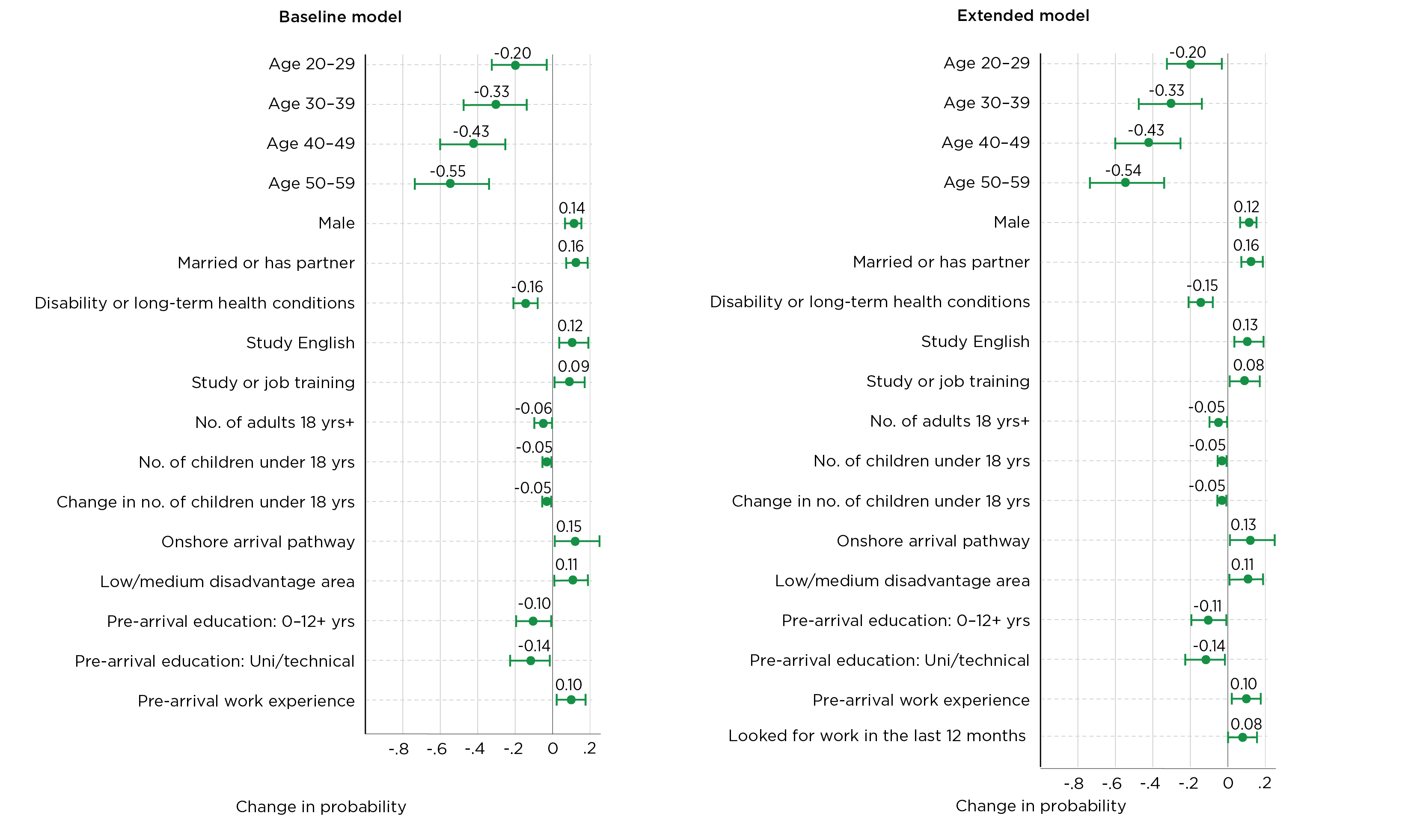
Figure 5 extends the earlier descriptive analysis and shows the impact of the factors on the likelihood of employment transition from income support payments by the 5th year of settlement. The first part of Figure 5 presents statistically significant results from the baseline model (i.e. Approach 1), using key predictors, while the second part shows how the results change when the additional factor of job-seeking status is included.18,19
Personal characteristics
The baseline model indicates that as migrants aged, they were less likely to transition into employment and more likely to rely on income support payments.20 Humanitarian migrants aged 50–59 (the oldest group in the analysis), for example, were 55 percentage points less likely to transition to employment compared to those aged 15–19.
Male migrants and those who were married were more likely to transition to employment compared to their female counterparts and those who were single. For males, this could reflect perceptions of responsibility but its effect may vary depending on household composition and caregiving commitments. Similarly, marital status may create a need to engage in income-generating activities (Al-Hamad et al., 2024; van Kooy et al., 2024).
In terms of personal skills, studying English, undertaking other studies or job training in Australia and pre-arrival work experience all contributed to the transition to employment by year 5.21 These findings reinforce the predictions of individual attributes discussed in Part 1.
Moreover, humanitarian migrants who arrived via the onshore arrival pathway were more likely to transition to work by year 5. Onshore arrivals tended to be predominantly younger, single and male when compared to offshore arrivals. They have usually spent more time in Australia, which may have given them greater familiarity with employment systems and, consequently, a better ability to transition to work over time (van Kooy et al., 2025).
However, humanitarian migrants with disabilities or long-term health conditions22, 23 were less likely to transition to employment than those without such conditions. While direct evidence of employment motivation among humanitarian migrants with disabilities or long-term health conditions is limited, broader research suggests that humanitarian migrants with disabilities often experience low labour force participation due to limited access to inclusive services, ongoing health challenges and systemic discrimination (Tan et al., 2025).
Those with formal education before arriving were also less likely to transition to employment than those without formal education.24 This may be because those with formal education often face their existing skills and qualifications not being recognised in Australia, leading some to remain on income support payments or accept jobs below their skill level while continuing to rely on government income support (van Kooy et al., 2024).25
Family characteristics
Turning to family characteristics, more adult members in the family decreased the probability of employment transition by 6 percentage points for humanitarian migrants. As discussed in Part 1, some households include more adult members who are elderly or have disabilities. This suggests that the additional caring responsibilities associated with these family members may either disrupt humanitarian migrants’ ability to enter the workforce due to shared responsibilities or compel them to withdraw from it (van Kooy et al., 2025).
Having dependent children under 18 years also decreased the likelihood of transition to employment for humanitarian migrants; in this case, by 5 percentage points. The presence of young children – particularly children born between years 1 and 5 and therefore under 5 years of age at year 5– was associated with lower rates of employment transition and a higher likelihood of continued reliance on government income support. This is indicative of the fact that for a lack of child care and the need to care for young children potentially restricts humanitarian migrants from participating in the labour market. van Kooy and colleagues (2025) show that the effects of having children may vary by sex because of differences in gender roles (see discussion below).
The other notable finding was that humanitarian migrants living in low to medium disadvantage areas were more likely to transition to employment than their counterparts in high-disadvantage areas. This may be attributable to people in high disadvantage areas facing greater barriers to work, such as limited access to transport and affordable housing located near employment opportunities (Olliff, 2010). On the other hand, those residing in better resourced areas are often located closer to employment hubs, public transport and job services, which can improve access to roles more closely aligned with migrants’ skills and qualifications (van Kooy et al., 2025).
Figure 5: Determinants of employment transition from income support payments, between year 1 and year 5 of settlement
View full screen.
Notes: Error bars indicate the significance levels of 0.05, 0.01 and 0.001. Variables with confidence intervals that cross the 0.0 line (black line) are not significantly associated with the outcome. Sample limited to BNLA participants aged 15–59. For the complete regression results, see Table D3 in Appendix D.
Reference groups: Age: 15–19, female, not married/no partner, no disability, never studied English, not undertaken other study or job training, offshore arrival pathway, high disadvantage area, pre-arrival education: no formal education, no pre-arrival work experience, and not looked for work in the last 12 months.
Source: BNLA Waves 1 (year 1: 2013–14) and 5 (year 5: 2017–18)
Job seeking and local employment conditions
The extended model in Figure 5 suggests that adding job-search status did not substantially alter the main findings, indicating that the baseline model is likely robust. It was found that job search activities increased the probability of employment transition compared with those who did not undertake these activities. This aligns with findings from the broader Australian population, who have similarly relied on government income support (Cai et al., 2008).26
It is worth noting that even humanitarian migrants who actively engage in job search activities may remain unsuccessful due to structural barriers. This was particularly evident in the analysis: once baseline local unemployment rates were taken into account, job search activities no longer had a significant impact on employment outcomes.
Looking for work becomes a positive and significant factor when combined with the unemployment rate in year 5 (see Table D3, Appendix D). This likely reflects the decline in unemployment by year 5 (October–December 2017 to January–March 2018), which made early job search efforts more effective in a stronger labour market. For example, humanitarian migrants who were actively seeking work at baseline (October–December 2013 to January–March 2014) appeared better positioned to benefit from improved conditions over time. In contrast, their efforts had less impact due to the higher unemployment rates upon arrival in Australia. This finding highlights the importance of sustained job search support and policies that help humanitarian migrants to remain engaged until labour market opportunities expand.
By the 10th year of settlement
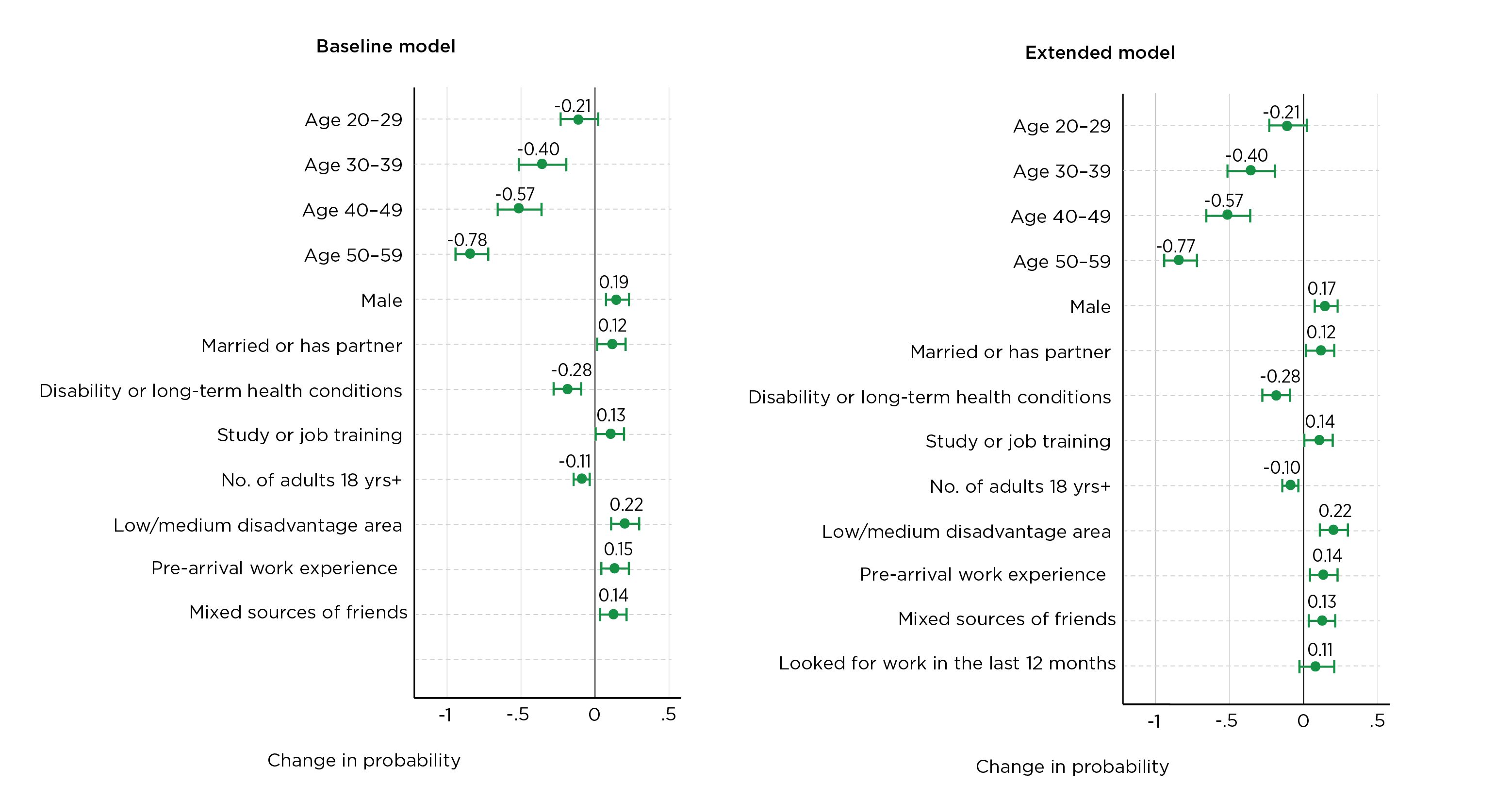
Figure 6 illustrates the impact of the factors on the likelihood of employment transition from income support payments by the 10th year of settlement.27 The first part of Figure 6 presents statistically significant results from the baseline model, using key predictors, while the second part examines how the results change when incorporating job-seeking status.
Personal and family characteristics
In both the baseline and extended models, most explanatory variables that influenced employment transition by the 5th year of settlement were also significantly associated with employment transition by the 10th year of settlement. The exceptions were studying English, pre-arrival education,28 the number of children under 18, and the onshore arrival pathway.
It may be that studying English in the early settlement period, along with pre-arrival education and the migration arrival pathway, are no longer relevant predictors of employment transition after a decade of residence. This could be because their impact is accounted for by other factors, such as accumulated work experience and improved language proficiency through daily use over time (Ahmed et al., 2025; Kuschel et al., 2023; Picot & Li, 2020).
In addition, while dependent children were a significant barrier in year 5, their influence was not relevant by year 10. This may reflect reduced caregiving intensity as children age, improved parental adaptation and the growing importance of other factors, such as access to additional study or job training and improved social connectedness (Al-Hamad et al., 2024; Flavel et al., 2024; Ziersch et al., 2022).
The other notable finding was the role of social ties for employment transitions for humanitarian migrants. Having friends from outside their own ethnic or religious group was found to increase the probability of employment transition by the 10th year of settlement in both the baseline and extended models. This finding supports the influence of social networks on social and economic integration over the longer time (Brell et al., 2020).29
Job seeking and local employment conditions
The extended model again confirms that job search activity increased the likelihood of employment transition compared with those who did not engage in these activities. However, its impact was no longer significant by year 10, once baseline local unemployment rates were taken into account (see Table D4, Appendix D). When paired with the unemployment rate in year 10 (i.e. January–July 2023), job search becomes positive and significant, reflecting the sharp decline in unemployment post-COVID, from around 7% in 2020 to around 4% by 2023.30
This suggests that humanitarian migrants who actively sought work at baseline were better positioned to benefit from improved labour market conditions post-COVID. However, they remained at risk due to barriers such as a lack of credential recognition and other structural challenges. This underscores the importance of sustained job search support and strategies that maintain engagement during periods of high unemployment, ensuring humanitarian migrants can capitalise on labour market recovery phases.
Figure 6: Determinants of employment transition from income support payments, between year 1 and year 10 of settlement
View full screen.
Notes: Error bars indicate the significance levels of 0.05, 0.01 and 0.001. Variables with confidence intervals that cross the 0.0 line (black line) are not significantly associated with the outcome. Sample limited to BNLA participants aged 15–59. For the complete regression results, see Tables D4, Appendix D.
Reference groups: Age: 15–19, female, not married/no partner, no disability, not undertaken other study or job training, high disadvantage area, no pre-arrival work experience, no friends/mostly from ethnic/religious community, and not looked for work in the last 12 months.
Source: BNLA Waves 1 (year 1: 2013–14) and 6 (year 10: 2023)
Differences in findings for men and women
This section examines differences between men and women using separate models for each group at the 5th (Figure 7) and 10th years of settlement (Figure 8). The figures show results for one sex only, and the comparisons discussed are based on these separate model results. These results aim to determine whether certain factors affect men and women differently when entering the workforce.
By the 5th year of settlement
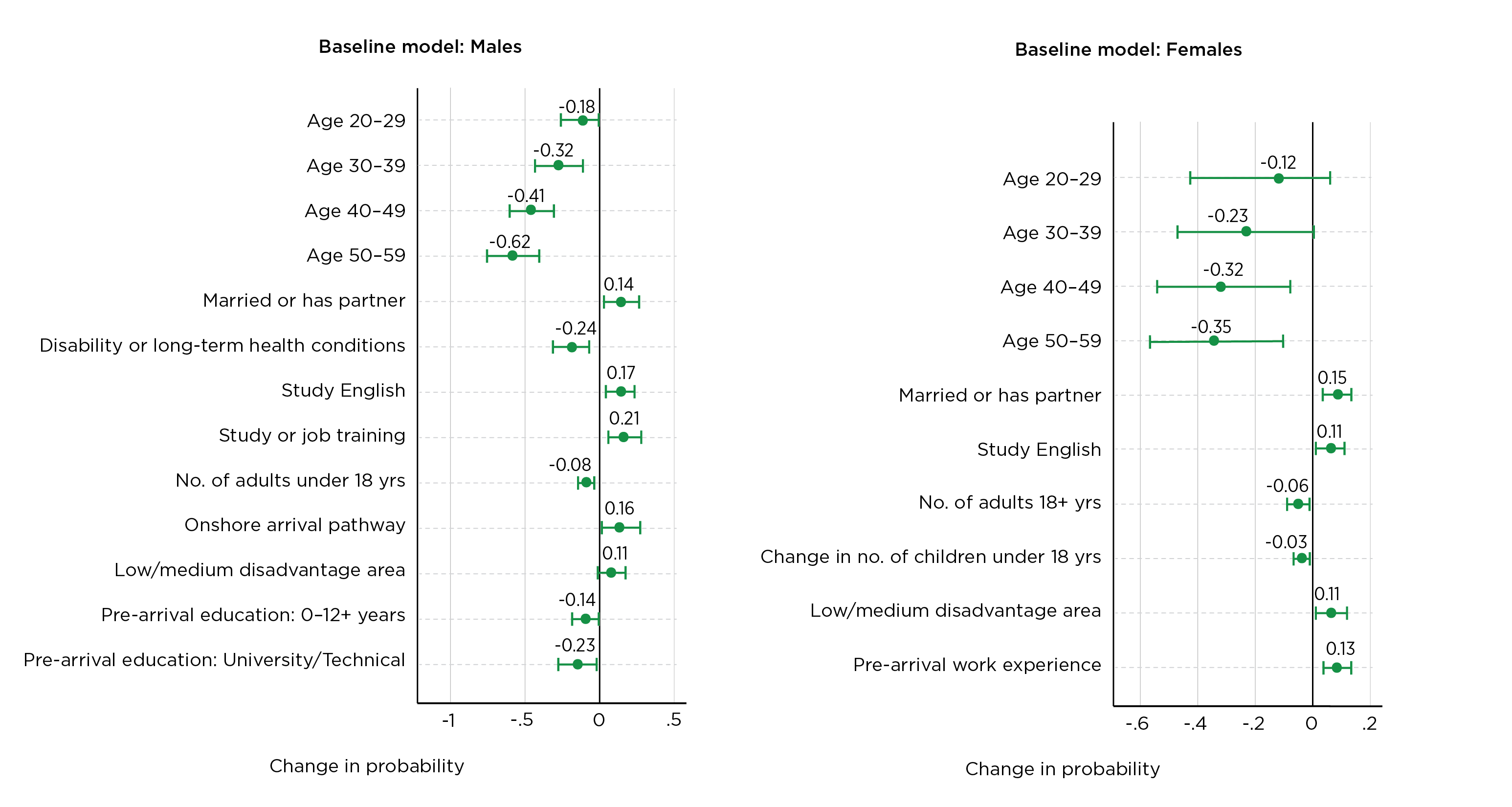
Figure 7 illustrates the factors influencing the likelihood of employment transition by the 5th year of settlement by sex.31 The results for men were consistent with those observed in the full model in Figure 5. The consistency between male-specific results and the full model suggest that the observed relationships varied by sex.
Migrating at an older age was associated with a lower likelihood of transitioning to employment. For both men and women, the likelihood of not transitioning to employment – or being more reliant on government income support – was highest among those aged 50–59.
Studying English, being married and living in a low to medium disadvantage area were linked to a higher likelihood of transitioning to employment. These patterns were consistent across both men and women. For married men, cultural norms often position them as primary earners, which increases their motivation to seek employment and reduce reliance on income support payments (Ortlieb et al., 2024; Yalim & Critelli, 2023).
On the other hand, married women are less likely to enter the work force due to caregiving responsibilities or because household income is sufficient, especially when supported by a spouse’s earnings or shared household resources (Al-Hamad et al., 2024; Harris, 1993). The findings in this study therefore suggest that, for some married women, economic participation is not solely driven by necessity but may also be influenced by personal choice, health conditions or broader family dynamics and cultural influences.32
For men, undertaking other education or training in Australia33 and arriving via onshore pathways also increased the likelihood of employment transition by year 5, by 21 percentage points and 16 percentage points, respectively. However, there were several factors that reduced the likelihood for men, including having disabilities or long-term health conditions,34 living with dependent children under 18 years and holding pre-arrival educational qualifications.
Men with disabilities or long-term health conditions were 24 percentage points less likely to transition to employment by year 5, while men with pre-arrival formal education were 14 percentage points less likely to transition by this time. Additionally, each dependent child under 18 was associated with an 8 percentage point reduction in the probability of an employment transition. This finding reinforces earlier evidence that caregiving responsibilities also impact resettled migrant men (van Kooy et al., 2025).
For women, pre-arrival work experience increased the likelihood of employment transition by year 5 by 13 percentage points. However, family characteristics such as the number of adults in the household and changes in the number of dependent children under 18 reduced this likelihood. A possible explanation for this trend is that caring for larger households, including those with newborns, can deter women from pursuing employment opportunities, regardless of other demographic characteristics (van Kooy et al., 2025).
Figure 7: Determinants of employment transition from income support payments, between year 1 and year 5 of settlement by sex
View full screen.
Notes: Error bars indicate the significance levels of 0.05, 0.01 and 0.001. Variables with confidence intervals that cross the 0.0 line (black line) are not significantly associated with the outcome. Sample limited to BNLA participants aged 15–59. For the complete regression results, see Tables D7, Appendix D.
Reference groups: Age: 15–19, not married/no partner, no disability, never studied English, not undertaken other study or job training, offshore arrival pathway, high disadvantage area, pre-arrival education: no formal education, and no pre-arrival work experience.
Source: BNLA Waves 1 (year 1: 2013–14) and 5 (year 5: 2017–18)
By the 10th year of settlement
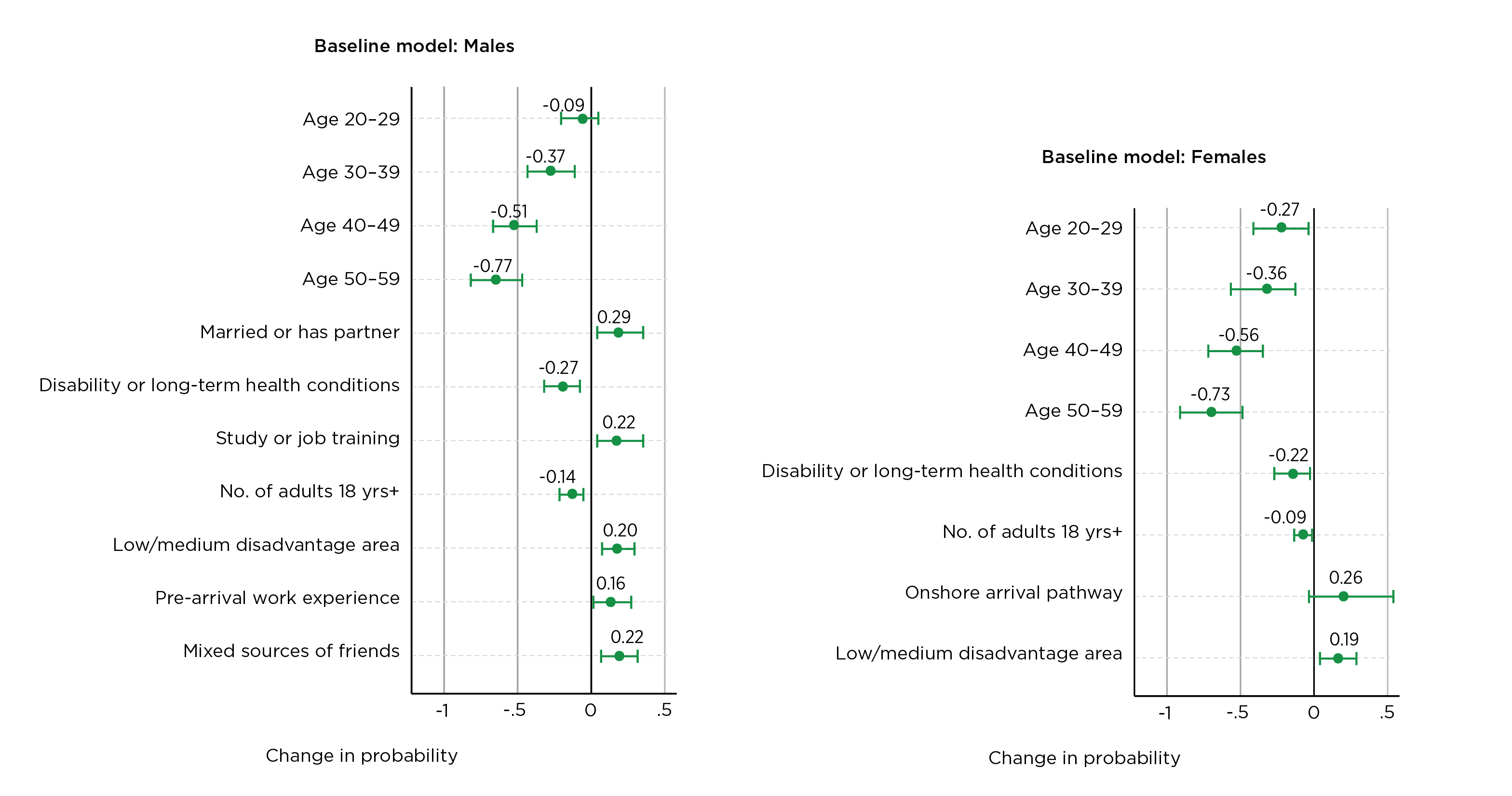
Figure 8 shows the factors influencing the likelihood of employment transition by the 10th year of settlement, by sex.35 As before, the findings for men, when analysed separately, did not differ significantly from the overall results that included both men and women (Figure 6).
There were some differences in the findings at the 10th year of settlement, for both men and women, when compared to the likelihood of employment transition at the 5th year. In particular, pre-arrival work experience and having friends from a mix of cultural or ethnic backgrounds were only significantly associated with employment transitions for men.36 On the other hand, the onshore arrival pathway appeared to be only a significant predictor of the probability of employment transition for women.
In addition, the number of adults in the family emerged as a significant factor in reducing the likelihood of employment transition for men, as it already was for women. However, pre-arrival formal education was no longer a significant predictor of employment transition for men. For women, being married, changes in the number of dependent children and pre-arrival work experience also lost statistical significance.
Moreover, studying English in year 1 was no longer relevant for employment transition for either men or women at the 10th year of settlement. It may be that migrants who studied English in year 1 reached a functional level of proficiency earlier than those who did not study but, by year 10, the differences in English skills had narrowed due to informal learning, workplace exposure or community interaction (Kuschel et al., 2023; Picot, & Li, 2020).
Figure 8: Determinants of employment transition from government, between year 1 and year 10 of settlement by sex
View full screen.
Notes: Error bars indicate the significance levels of 0.05, 0.01 and 0.001. Variables with confidence intervals that cross the 0.0 line (black line) are not significantly associated with the outcome. Sample limited to BNLA participants aged 15–59. For the complete regression results, see Tables D8, Appendix D.
Reference groups: Age 15–19, not married/no partner, no disability, not undertaken other study or job training, offshore arrival pathway, high-disadvantage area, and no pre-arrival work experience.
Source: BNLA Waves 1 (year 1: 2013–14) and 6 (year 10: 2023)
Taken together, several variables that were not statistically significant by the 5th year of settlement became significant by the 10th year, and vice versa, both for men and women. These changes suggest that the influence of these variables on employment transitions strengthens or weakens over time. This may reflect delayed or overlapping effects with other factors in the analysis, shifts in sample composition due to higher attrition rates by year 10 or changes in household and labour market conditions over the longer term (e.g. children becoming adults or changes in employment rates over time).
The analysis also suggests some gender-specific drivers of the longer-term transition from government income support to employment as the main income source. For men, participation in study or job-related training in Australia and living in areas of low or medium disadvantage were strongly associated with improved employment outcomes over time, with these positive effects intensifying by year 10. In contrast, having disability or a long-term health condition had a negative impact that worsened by year 10.
For women, living in less disadvantaged areas also emerged as the strongest factor for sustained transition to employment as a main income source. In contrast, larger household composition (more adults aged 18 and above) reduced the likelihood of employment transition over time, with this effect worsening by year 10.
Additional evidence and validation checks
This section provides a brief overview of the key analytical considerations that underpin the baseline findings, as summarised in Box 1. A more detailed discussion of the extended analyses and robustness checks is provided in Appendix C, with supporting data presented in Appendix D. The methodological framework guiding these extended analyses is documented in Appendix A.
Understanding selection effects in employment transitions
It is argued that those who do transition to employment tend to be a self-selected group – potentially different from those who remain reliant on government income support. These differences are not incidental; they reflect underlying disparities in the demographic characteristics presented in Tables 3 and 4.
This study accounted for differences in the types of humanitarian migrants included in the analysis. This helped ensure that the findings on employment transitions in years 5 and 10 discussed above were more accurate –particularly in showing how the strength and direction of the effects may change depending on who is included. When compared with baseline estimates in Figures 5 and 6, the adjusted results remained consistent in direction and strength, suggesting that the findings are reliable and not distorted by selection bias (see Table D9, Appendix D).
Insights from those who stay and those who leave the BNLA study
It is likely that some participants who withdrew after the baseline survey in year 1 were among the key recipients of government income support, or they had successfully transitioned to employment. This loss of participants may have affected the representativeness of the remaining sample, potentially leading to biased estimates of employment transitions – especially those presented in Figures 5 and 6.
This study examined whether participant attrition over time influenced baseline results. More specifically, correcting for attrition helps ensure that the results more accurately reflect the broader population, especially when designing policies to support long-term employment transition among humanitarian migrants.
It was found that attrition did not introduce systematic bias to the estimation of the employment transition.37 In other words, the characteristics influencing survey retention do not appear to correlate with the determinants of the employment transition itself. As a result, the primary findings from Figures 5 and 6 can be considered robust, even without correction for panel attrition bias (see Tables D10 and D11, Appendix D).
Understanding employment transition from income support payments: insights from alternative outcomes
To strengthen the evidence base and enhance the relevance of findings, this study considered 2 additional outcomes. First, participants who received income support payments in year 1 but transitioned to work in year 5 and year 10. Second, participants who received income support payments in year 1 but transitioned to work in year 5 or year 10. Overall, the findings are robust to different outcome measures and remain consistent despite changes in sample size when including both years 5 and 10 in the analysis (see Table D12, Appendix D).
Understanding income support payments and employment status: insights from each survey wave
Humanitarian migrants often rely on income support payments as their primary source of income upon arrival; however, many also find employment at some point in time (see Table D13, Appendix D). Accordingly, this study considered the third outcome measure with 3 possible categories:
- participants who were unemployed and received income support payments
- participants who were not in the labour force (NILF) and received income support payments
- participants who were employed but received income support payments, along with those employed whose main income source was wages/salaries.
This analysis was conducted by waves to highlight the differential impacts over time.38 Over time, humanitarian migrants showed a gradual shift from income support payments to employment. In year 1, being male, having disability or a long-term health condition, studying English, having pre-arrival work experience and family composition were all factors that strongly influenced the likelihood of employment (with or without income support payments) (Table D14, Appendix D).
By year 5, these factors remained relevant for employment (with or without income support payments), with pre-arrival formal education emerging as a barrier due to skill mismatch (though not statistically significant) (Table D15, Appendix D). In year 10, the influence of English skills, training and family dynamics declined, while pre-arrival education became positively linked to employment (with or without income support payments), suggesting delayed benefits as settlement conditions improved (Table D16, Appendix D).
Overall, the findings reinforce the baseline estimates of employment transitions at the 5th and 10th years of settlement, with only a few notable exceptions. They also highlight evolving drivers of employment outcomes and the importance of long-term support strategies.
Conclusion
Over the first decade of settlement in Australia, humanitarian migrants in the BNLA study exhibited a significant shift away from reliance on government income support toward increased engagement in paid employment. This shift was influenced by several factors – some acting as enablers, while others made it harder – and their impact changed over time.
What helped humanitarian migrants transition into employment?
Early participation in English language study facilitated initial movement into employment by 12 percentage points at year 5, though its impact was not statistically significant by year 10. In contrast, involvement in job training and further education in Australia was associated with more sustained employment uptake: 9 percentage points in year 5 and 13 percentage points in year 10. Pre-arrival work experience proved beneficial, though its influence varied over time, improving the likelihood by 10 percentage points in year 5 and 15 percentage points in year 10, while pre-arrival formal education, under certain circumstances (after controlling for other factors in the analysis), showed limited or even negative effects by year 5. Over the longer term, diverse social networks increasingly supported the transition of humanitarian migrants into the workforce with an impact of up to 14 percentage points in year 10.
What made it harder?
Personal and family circumstances, such as disability or long-term health conditions, household composition and caregiving responsibilities, consistently constrained employment progression. In particular, having disability or a long-term health condition was associated with a reduction of 28 percentage points in the likelihood of employment transition by year 10.
These findings were robust after accounting for self-selection into employment, panel attrition and alternative outcome measures.
Differences in transition to employment by sex
Gendered patterns shaped the pathways from government income support to paid employment over the 10-year period of the BNLA study. Women steadily progressed toward closing the employment gap by year 10, yet their early transitions were more constrained by caregiving responsibilities and household structure. These factors limited their ability to engage in work or training, delaying their movement to paid employment.
Women showed earlier gains from pre-arrival work experience, increasing the likelihood of employment transition by 13 percentage points in year 5, while men benefited later, with an increase of 17 percentage points in year 10. Men also experienced stronger long-term advantages from early job training and expanding social networks, improving employment transition by 22 percentage points in year 10. In contrast, the lack of sustained benefits from early study and training for women pointed to enduring structural constraints that influenced their employment trajectories.
The role of disability or long-term health conditions in the transition to employment by sex
Disability or long-term health conditions status further compounded gender patterns by year 10. While disability or long-term health conditions was more commonly reported among men, its impact on their employment transitions became especially pronounced by year 10, reducing the likelihood by 27 percentage points. For women with disabilities or long-term health conditions, caregiving demands and structural constraints further reduced labour force participation, making them 22 percentage points less likely to transition from income support payments to paid work than women without disabilities or long-term health conditions in year 10. This reinforces the need to understand how disability or long-term health conditions intersect with gender in shaping employment trajectories.
Relevance for policy and practice
English study alone may not be sufficient for a longer-term pathway to employment
Early English language study is associated with short-term employment gains, and this pattern holds for both men and women. The Adult Migrant English Program (AMEP) report supports this trend, indicating that AMEP participation helps reduce income support reliance gradually – men from year 2 and women from year 4 post-enrolment (Telethon Kids Institute & The University of Western Australia, 2022).
Early English study, however, did not ensure a long-term transition to employment. This trend underscores that English proficiency alone does not guarantee long-term labour market integration. Building vocational capabilities and gaining Australian work experience are also crucial for shifting away from long-term reliance on income support and enhancing job security (Renzaho et al., 2025).
In particular, targeted vocational training in high-demand sectors is essential for improving long-term employment outcomes for humanitarian migrants. Health care and social assistance, for example, is the most prominent sector, employing 42% of humanitarian migrant women in Australia, with strong demand for roles in aged care, disability support and community services (AIFS, 2015).
Digital literacy is equally critical, as studies show that a lack of basic IT skills limits access to job platforms and workplace communication, making training in data entry, online tools and cyber safety essential (Potocky, 2021; Shah, 2024; van Kooy et al., 2025).
Early assessment of skills and qualification recognition
Pre-arrival work experience is a strong predictor of employment transition, though the timing of its impact varies by sex. This underscores the need for gender-responsive and time-sensitive support. Early recognition of overseas experience – particularly for women – can improve employment prospects (Al-Hamad et al., 2024) and support transition to paid work over the longer term. Continued monitoring of employment outcomes over time is crucial for refining interventions and addressing evolving barriers.
Pre-arrival formal education may not translate to employment, and this evidence was consistent for both men and women. This highlights the clear need to streamline and subsidise the process for recognising overseas qualifications (van Kooy et al., 2025).
For example, establishing a central agency to coordinate skills recognition and provide guidance through professional accreditation processes would reduce barriers and enable more refugees and humanitarian migrants to contribute their skills to the Australian economy. While programs such as AMES Australia’s Skilled Professional Migrant Program (SPMP) and Trades Recognition Australia provide pathways for skills recognition, the process remains complex, costly and often difficult to navigate, particularly for newly arrived humanitarian migrants (Batainah et al., 2022).
Addressing employment barriers for humanitarian migrants with disabilities or long-term health conditions
Humanitarian migrants with disabilities or long-term health conditions face persistent and worsening barriers in their transition to paid work. For men, these barriers persist up to 10 years post-arrival; for women, they become evident by year 10. This suggests that short-term interventions are insufficient and highlights the need to monitor employment trajectories beyond the initial 5 years. Sustained support, such as workplace accommodations, health-integrated employment pathways and structured assistance for labour market transitions, is also essential. Taken together, the health needs of culturally and linguistically diverse humanitarian migrants living with disability or long-term health conditions must be recognised, and services should be tailored to meet those needs.
Addressing this evidence gap is critical to developing targeted, adaptive policies that reflect the long-term experiences of humanitarian migrants, especially those with disabilities. Given the absence of centralised government data on the number of humanitarian migrants with disabilities arriving in Australia, establishing a Resettlement Submission Category for humanitarian migrants with disabilities would support coordinated service planning by identifying the number of arrivals and the support they may require (Duell-Piening, 2018).
While there is limited published evaluation evidence on the effectiveness of specific employment programs for humanitarian migrants with disabilities, recent disability employment reforms have sought to expand access to more tailored and flexible support models. For example, the Inclusive Employment Australia initiative aims to broaden the range of specialist providers available to participants with disabilities, including those from culturally and linguistically diverse backgrounds and humanitarian migrant communities.39
Household composition shapes employment transition over time
Larger adult households were associated with a reduced likelihood of employment transition for women at the 5th and 10th years of settlement and for men in year 10. Similarly, having more children under 18 was associated with lower employment transition rates for both men and women in year 5. These aspects highlight that employment support programs should consider household dynamics and be aware that, particularly in larger adult households, shared responsibilities or caregiving roles may limit an individual’s capacity to actively seek work.
Access to child care significantly enhances the participation of humanitarian migrant women in work and education, thereby facilitating their transition to employment (Gambaro et al., 2024). Further research is needed on multigenerational households, where caregiving for elderly or disabled family members often limits labour market participation. The International Labour Organisation (ILO) notes that migrant women’s caregiving roles reflect both structural barriers and personal choice (King-Dejardin, 2019).
Tailored interventions, such as individualised employment plans, flexible scheduling and access to respite services, can help mitigate these constraints and improve transition to employment. However, the limited understanding of women’s employment trajectories and the reasons they remain at home or receive government income support points to a critical evidence gap. Addressing this evidence gap through targeted research – including qualitative studies that capture women’s lived experiences and decision-making processes – will ensure that policies are responsive to their diverse needs.
Building social capital and networks with people from diverse ethnic and religious backgrounds
Social networks acted as a facilitator to employment transition; however, only for men after 10 years. While social networks did not appear to directly influence women’s employment transitions in this study, broader research indicates that social connectedness remains beneficial for their employment trajectories as well (Ziersch et al., 2023). The differing impacts may reflect gendered variations in network composition among humanitarian migrants – where men are more likely to engage through formal or religious networks, and women through community-based connections (Hartmann & Steinmann, 2021). These distinctions among humanitarian migrants warrant further investigation to better understand how social capital influences transition to employment for both men and women.
Taken together, settlement services that foster social networks among humanitarian migrants should continue, with emphasis on cross-cultural events, industry visits and mentorships to build diverse ties. Collaborations with professional associations and community groups can further support long-term career development (Whitaker et al., 2018). This is important because informal support has a lasting positive impact on employment transitions, particularly for men, and because individuals benefit from participating in networks that foster intercultural understanding and stronger, more connected communities (Smith et al., 2023).
References
Ahmed, S., Kooy, J. van, & Andersson, C. (2025). English language skills of humanitarian migrants in Australia. Policy Brief. Melbourne: Australian Institute of Family Studies.
Al-Hamad, A., Yasin, Y. M., & Metersky, K. (2024). Predictors, barriers, and facilitators to refugee women’s employment and economic inclusion: A mixed methods systematic review. PLOS One, 19(7), e0305463.
Australian Bureau of Statistics (ABS). (2024, June 26). Migrant Settlement Outcome. ABS.
Australian Bureau of Statistics. (2023, April 27). Socio-Economic Indexes for Areas (SEIFA), Australia. ABS. www.abs.gov.au/statistics/people/people-and-communities/socio-economic-indexes-areas-seifa-australia/latest-release#index-of-relative-socio-economic-disadvantage-irsd-
Australian Human Rights Commission (AHRC). (2016). Willing to work: National inquiry into employment discrimination against older Australians and Australians with disability. AHRC.
Australian Institute of Family Studies (AIFS). (2015). Building a New Life in Australia: Wave 2 Main Fieldwork Report. Melbourne: AIFS.
Batainah, H., Hawkins, J., & Miranti, R. (2022). Untapped potential: Trends and disparities in the economic potential of migrant and refugee women in Australia (Occasional Paper No. 4). NATSEM and Settlement Services International. www.ssi.org.au/images/insights/OP_Untapped_Potential_Report.pdf
Brell, C., Dustmann, C., & Preston, I. (2020). The labour market integration of refugee migrants in high-income countries. Journal of Economic Perspectives, 34(1), 94–121. doi.org/10.1257/jep.34.1.94
Cai, L., Mavromaras, K., Zakirova, R., & Folk, Y. K. (2008). Human capital and the pattern of employment and welfare receipt (No. 08/2007). Melbourne Institute of Applied Economic and Social Research.
Cortis, N., Bullen, J., & Hamilton, M. (2013). Sustaining transitions from welfare to work: The perceptions of employers and employment service providers. Australian Journal of Social Issues, 48(3), 363–384.
doi.org/10.1002/j.1839-4655.2013.tb00287.x
Department of Home Affairs. (2025, July 16). Australia’s Humanitarian Program 2025–26. Australian Government. www.homeaffairs.gov.au/reports-and-publications/submissions-and-discussion-papers/australias-humanitarian-program-2025-26
Due, C., Callaghan, P., Reilly, A., Flavel, J., & Ziersch, A. (2025). Employment for women with refugee and asylum seeker backgrounds in Australia: An overview of workforce participation and available support programmes. International Migration, 63(1), e12848. doi.org/10.1111/imig.12848
Duell-Piening, P. (2018). Refugee resettlement and the Convention on the Rights of Persons with Disabilities. Disability & Society, 33(5), 661–684. doi.org/10.1080/09687599.2018.1444582
Flavel, J., Due, C., Howe, J., & Ziersch, A. (2024). Refugee women and work: Evidence from an Australian longitudinal study. International Migration. doi.org/10.1111/imig.13326
Gambaro, L., Huebener, M., Schmitz, S., & Spiess, C. K. (2024). Unlocking potential: Childcare services and refugees’ integration, employment and well-being. doi: 10.13140/RG.2.2.34137.12645
Hansen, J., & Lofstrom, M. (2011). Immigrant-native differences in welfare participation: The role of entry and exit rates. Industrial Relations: A Journal of Economy and Society, 50(3), 412–442.
doi.org/10.1111/j.1468-232X.2011.00644.x
Harris, K. M. (1993). Work and welfare among single mothers in poverty. American Journal of Sociology, 99(2), 317–352.
Hartmann, J., & Steinmann, J.-P. (2021). Do gender-role values matter? Explaining new refugee women’s social contact in Germany. International Migration Review, 55(3), 688–717.
doi.org/10.1177/0197918320968481
Hebbani, A. (2014). The impact of religious difference and unemployment/underemployment on Somali former refugee settlement in Australia. Journal of Muslim Mental Health, 8(1).
doi.org/10.3998/jmmh.10381607.0008.103
Heggebø, K., Dahl, E., & Van Der Wel, K. A. (2020). Disentangling the dynamics of social assistance: A linked survey – Register data cohort study of long-term social assistance recipients in Norway. PLOS One, 15(3), e0230891. doi.org/10.1371/journal.pone.0230891
King-Dejardin, A. (2019). The social construction of migrant care work: At the intersection of care, migration and gender. International Labour Organization Report, 42, 978–992.
Königs, S. (2018). Micro-level dynamics of social assistance receipt: Evidence from four European countries. International Journal of Social Welfare, 27(2), 146–156. doi.org/10.1111/ijsw.12279
Kuschel, A., Hansen, N., Heyse, L., & Wittek, R. P. M. (2023). Combining language training and work experience for refugees with low-literacy levels: A mixed-methods case study. Journal of International Migration and Integration, 24(4), 1635–1661. doi.org/10.1007/s12134-023-01028-6
Lai, H., Due, C., & Ziersch, A. (2022). The relationship between employment and health for people from refugee and asylum-seeking backgrounds: A systematic review of quantitative studies. SSM – Population Health, 18, 101075. doi.org/10.1016/j.ssmph.2022.101075
Lewis, V. A., MacGregor, C. A., & Putnam, R. D. (2013). Religion, networks, and neighborliness: The impact of religious social networks on civic engagement. Social Science Research, 42(2), 331–346.
doi.org/10.1016/j.ssresearch.2012.09.011
Macaluso, C. (2021). The shortcomings of a work-biased welfare system. Economic Brief, 21(15).
www.richmondfed.org/publications/research/economic_brief/2021/eb_21-15
Mood, C. (2013). Social assistance dynamics in Sweden: Duration dependence and heterogeneity. Social Science Research, 42(1), 120–139. doi.org/10.1016/j.ssresearch.2012.07.005
Olliff, L. (2010). What works: Employment strategies for refugee and humanitarian entrants. Sydney: Refugee Council of Australia.
Ortlieb, R., Baumgartner, P., Palinkas, M., Eggenhofer-Rehart, P., & Ressi, E. (2024). Employment outcomes of refugee women and men: Multiple gender gaps and the importance of high-skill jobs. Journal of Ethnic and Migration Studies, 50(20), 4987–5008. doi.org/10.1080/1369183X.2024.2379945
Picot, G., & Li, X. (2020). Which immigration selection factors best predict the earnings of economic principal applicants? (Nos. R3c-2020). www.canada.ca/en/immigration-refugees-citizenship/corporate/reports-statistics/research/immigration-selection-factors-predict-earnings-economic-principal-applicants.html
Potocky, M. (2021). The role of digital skills in refugee integration: A state-of-the-art review. The International Journal of Information, Diversity, & Inclusion (IJIDI).
Renzaho, A. M. N., Woodward, K., Polonsky, M., Abood, J., & Green, J. (2025). Addressing employment barriers for humanitarian migrants: Perspectives from settlement services. Australian Journal of Social Issues, 60(1), 40–59. doi.org/10.1002/ajs4.353
Sarkar, S., Sahoo, S., & Klasen, S. (2019). Employment transitions of women in India: A panel analysis. World Development, 115, 291–309. doi.org/10.1016/j.worlddev.2018.12.003
Services Australia. (2025). Payment for refugees and asylum seekers: Moving to Australia. Services Australia. www.servicesaustralia.gov.au/payment-for-refugees-and-asylum-seekers?context=60041
Shah, M. H. (2024). Addressing equity and disability gaps in immigrant and refugee communities: A psycho-socio-educational framework. In G. Bennett & E. Goodall (Eds.), The Palgrave encyclopedia of disability (pp. 1–13). Springer Nature Switzerland. doi.org/10.1007/978-3-031-40858-8_291-1
Shahidi, F. V., Ramraj, C., Sod-Erdene, O., Hildebrand, V., & Siddiqi, A. (2019). The impact of social assistance programs on population health: A systematic review of research in high-income countries. BMC Public Health, 19(1), 2. doi.org/10.1186/s12889-018-6337-1
Shergold, P. B. (2019). Investing in refugees, investing in Australia: The findings of a review into integration, employment and settlement outcomes for refugees and humanitarian entrants in Australia. Department of the Prime Minister and Cabinet.
Shin, S. (2022). To work or not? Wages or subsidies? Copula-based evidence of subsidized refugees’ negative selection into employment. Empirical Economics, 63(4), 2209–2252.
doi.org/10.1007/s00181-022-02202-y
Smart, D., De Maio, J. A., Rioseco, P., & Edwards, B. (2017). English skills, engagement in education, and entrance into employment of recently arrived humanitarian migrants. Research Summary. Australian Institute of Family Studies. aifs.gov.au/sites/default/files/publication-documents/bnla-researchsummary-eees-oct17_0.pdf
Smith, M. L., Racoosin, J., Wilkerson, R., Ivey, R. M., Hawkley, L., Holt-Lunstad, J. et al. (2023). Societal- and community-level strategies to improve social connectedness among older adults. Frontiers in Public Health, 11, 1176895. doi.org/10.3389/fpubh.2023.1176895
Stevenson, C., & Rioseco, P. (2024). Data users guide: Release 6.0. Australian Institute of Family Studies.
Tan, W., McMahon, T., Nguyen, T., & Goggin, G. (2025). Insights on refugees with disability in Australia: Foundations for belonging 2025. SSI/Institute for Culture and Society, Western Sydney University.
www.ssi.org.au/about-us/research-and-policy/
Telethon Kids Institute & The University of Western Australia. (2022). Adult Migrant English Program (AMEP) Impact Evaluation Project: Research paper D – Income support payment outcomes of AMEP clients. Department of Home Affairs.
van Kooy, J., Ahmed, S., Rioseco, P., & Marshall, D. (2025). Economic participation of humanitarian migrants in Australia. Melbourne: Australian Institute of Family Studies.
van Kooy, J., Woldegiorgis, M., & Rioseco, P. (2024). Building a New Life in Australia: 10 years of humanitarian settlement outcomes. Melbourne: Australian Institute of Family Studies.
Whitaker, L., Hughes, M., & Rugendyke, B. (2018). ‘I would call it a social capital building exercise’: The nature of networks that enable women with a refugee background to access sustainable employment in regional Australia. Journal of Social Inclusion, 9(2).
Yalim, A. C., & Critelli, F. (2023). Gender roles among Syrian refugees in resettlement contexts: Revisiting empowerment of refugee women and needs of refugee men. Women’s Studies International Forum, 96, 102670.
Ziersch, A., Due, C., Howe, J., Walsh, M., Miller, E., & Flavel, J. (2022). Pathways to employment for social inclusion, health & wellbeing for women from refugee backgrounds. Flinders University. mrhresearchgroup.com.au/wp-content/uploads/2022/06/Public-Report_Pathways-to-Employment-for-Social-Inclusion-Health-Wellbeing-for-Women-from-Refugee-Backgrounds_2022.pdf
Ziersch, A., Walsh, M., & Due, C. (2023). ‘Having a good friend, a good neighbour, can help you find yourself’: Social capital and integration for people from refugee and asylum-seeking backgrounds in Australia. Journal of Ethnic and Migration Studies, 49(15), 3877–3899.
doi.org/10.1080/1369183X.2023.2177628
1Here reliance on income support is defined as being where participants reported it as their main income source in the relevant survey year. This is purely a descriptive measure and does not imply any judgement on the role of income support.
2Social security provides a range of income support payments, such as Age Pension, Jobseeker, Youth Allowance, Austudy, ABSTUDY and Disability Support Pension. Additional financial assistance includes Rent Assistance, Pharmaceutical Allowance, Telephone Allowance, Utilities Allowance and the Health Care Card. For all details about support payments see Income support payments | Department of Social Services
3A humanitarian migrant includes refugees but also encompasses individuals who may not meet the strict legal definition of a refugee yet are granted visas under Australia’s Humanitarian Program due to substantial humanitarian need. This includes people affected by war, conflict or extreme living conditions (Department of Home Affairs, 2025).
6Humanitarian migrants are exempt from the waiting period required by other migrants to access payments and concession cards. Non-humanitarian migrants may need up to 4 years to access most payments and other supports.
7Data collected on the type of government income support payment in the BNLA was based on self-reported data and was not collected throughout the 10-year study.
8Although poor mental health can limit employment prospects, evidence shows that employment itself improves health outcomes, particularly mental wellbeing (Lai et al., 2022).
9The term ‘long-term reliance’ in the context of social security does not have a universally fixed definition. In this brief, it is used descriptively to refer to humanitarian migrants who reported income support as their main income source over an extended period. The analysis followed humanitarian migrants for 5 to 10 years to examine patterns of persistent reliance, as defined by their reported primary income source, and to identify factors associated with sustained patterns of income support use.
10Moreover, the findings of these studies are difficult to generalise due to inconsistencies in terminology used to describe income support payments, as well as methodological differences (i.e. differences in data collection methodology, survey instruments and statistical models/techniques used in analysis).
11It is worth noting that paid work as a main source of income is not feasible for everyone, nor is it the primary purpose of the humanitarian settlement program. The intent here is to better understand how to support those who are able and ready to move into paid employment.
12Figure 2 represents the first of the 2 perspectives in the conceptual framework, which serves as a practical framework for examining the transition from income support payments to employment in this brief (for details, see Appendix A).
13The choice of variables is guided by the literature including Al-Hamad et al. (2024), Hansen & Lofstrom (2011), Hebbani (2014), Sarkar et al. (2019) and van Kooy et al. (2024).
14This trend is also evident among humanitarian migrants in year 5 and year 10 (see Figure D5, Appendix D).
15BNLA data indicate that 11% of participants who did not enrol in the English language program were employed compared to 5% of those who enrolled. Australian Institute of Family Studies (AIFS) findings further indicate that, in year 1, English comprehension proficiency among humanitarian migrants in the labour force was almost twice (63%) as high as among those not in the labour force (32%) (Ahmed et al., 2025).
16Some participants may not be working and not receiving income support payments because their partner’s income (or, for dependent youth, their parent’s income) exceeds the means-testing threshold. The available BNLA data does not allow us to directly identify this ‘hidden cohort’. Moreover, the analytical sample is not structured at the couple level, which also limits the ability to identify these cases.
17Age cohorts are defined by participants’ age in year 1 (baseline) and remain fixed across all subsequent waves. For example, the 15–19 cohort refers to individuals who were aged 15–19 in year 1, even though they aged over time. Participants aged 60 or older were not included in year 1; however, those who moved into this age group during the study were retained in analyses for years 5 and 10 (though their numbers were very small).
18See Table D5 in Appendix D for results based on a sample restricted to respondents aged 15 years and above.
19Model specification tests using Pearson chi-square statistics show that the inclusion of additional variables significantly enhances the explanatory power of the logistic models.
20This pattern is likely true of the broader Australian population as well – individuals who become unemployed later in life often face greater challenges re-entering the workforce and may consequently rely more heavily on government income support (Australian Human Rights Commission, 2016).
21Pre-arrival speaking proficiency was initially examined in the analysis but not included in the final analysis, as its effect was masked by study or job-related training and social networking variables in the model.
22A similar pattern was observed among the broader Australian population. Labour force participation among people with disability in Australia remains consistently lower than for those without disability, despite some improvement, from 53.4% in 2015 to 60.5% in 2022, compared to over 83% for people without disability in both years. See ABS 2015 and ABS 2022.
23A similar result was observed among humanitarian migrants experiencing poor mental health (see Table D3, Appendix D).
24This trend differs from what is shown in Tables 3 and 4, which display the positive association between pre-arrival formal qualification and employment transitions in year 5 and year 10. Note, the link in year 5 is not statistically significant.
25BNLA data show that humanitarian migrants with formal education prior to arrival were more likely to settle in major cities; however, this geographic advantage did not consistently translate to employment outcomes. This disconnect is often attributed to systemic discrimination and the lack of recognition of overseas qualifications, which can result in occupational downgrading and prolonged reliance on government income support (van Kooy et al., 2025).
26While job search activities are generally associated with an increased likelihood of transitioning into employment – as expected and desired – this relationship may also reflect a self-selection effect. Specifically, individuals who do not engage in job applications are unlikely to secure employment, suggesting that the observed link between job-search activity and employment outcomes is not solely attributable to the activity itself. This form of selection bias was not addressed in the current study and falls outside its scope.
27See Table D6 in Appendix D for results based on a sample restricted to respondents aged 15 years and above.
28Pre-arrival speaking proficiency was also tested but showed no significant effect, so it was removed from the analysis.
29In year 5, social networks were marginally significantly associated with employment transition only when religion was excluded from the model, suggesting that religious affiliation may overlap with or mediate the effects of social ties – possibly because social networks are often formed through religious communities.
30See Labour Force, Australia, October 2025 | Australian Bureau of Statistics
31A statistical test suggested that the estimated effects of key variables differed significantly between male and female models (see the bottom of Table D7, Appendix D).
32This interpretation is supported by the BNLA data: married women in the sample were less likely to report disability or long-term health conditions and had comparable levels of formal education prior to arrival, compared with their non-married counterparts. These characteristics may reduce barriers to employment and enhance labour-market readiness, thereby increasing their likelihood of transitioning into work. However, cultural norms that emphasise traditional caregiving and home-based roles for women in some groups may also influence employment decisions and economic participation patterns (Due et al., 2025).
33BNLA data show that participation in further study or job training in years 5 or 10 – rather than in year 1 – was positively associated with employment transitions for women up to 10 years after arrival. This pattern highlights structural barriers that constrained women’s ability to engage in work-integrated learning during the early settlement period.
34BNLA data show that disability or long-term health conditions emerged as a significant barrier to employment transition for women in year 5, particularly when English language study is excluded from the analysis. This suggests that English proficiency may play a mediating role, improving access to health services and outcomes, and thereby reducing the impact of health-related barriers to employment.
35A statistical test suggested that the estimated effects of key variables differed significantly between male and female models (see the bottom of Table D8, Appendix D).
36For men in year 5, social networks were significantly associated with employment transition only when religion was excluded from the model, suggesting that religious affiliation may overlap with or mediate the effects of social ties – possibly because men’s networks are often formed through religious communities. This finding is also consistent with the literature, which suggests that men may rely more on formal or religiously structured networks than women (Lewis et al., 2013).
37The Inverse Mills Ratio (IMR) is a statistical tool used to check whether survey attrition (participants dropping out over time) introduces bias to the analysis (for a detailed discussion, see Appendix A). If IMR is significant, it means the likelihood of staying in the study is related to the factors being analysed – in this case, employment transition. In the analysis, IMR was statistically insignificant, indicating that attrition did not distort the results. This reinforces that the main findings on employment transition are robust and reliable, even without adjustment for attrition.
38The results should be interpreted with caution due to the limited sample sizes across different categories and years.
39See Inclusive Employment Australia | Department of Social Services
Acknowledgements
This brief was commissioned and funded by the Australian Government Department of Social Services (DSS). The authors would like to thank representatives from the DSS for their earlier feedback and guidance. We would also like to acknowledge the input from representatives of the Department of Home Affairs, the Department of Employment and Workplace Relations and the Australian Bureau of Statistics on an earlier draft.
For their considered feedback on drafts of this brief, the authors would like to thank Liz Neville, Catherine Andersson, Sean Martin, John De Maio, Mulu Woldegiorgis and Anna Scovelle.
Finally, we would like to extend special thanks to the individuals and families who participated in the BNLA study. Without the generous contributions of their time and insights over several years, this research would not have been possible.
The findings and views reported in this brief are those of the authors and should not be attributed to the Australian Government, the DSS or any of DSS’s contractors or partners.
Featured image: © GettyImages/SolStock
978-1-76016-437-9
27 March 2026